




Research shows wearable glucose sensors can help some people improve diabetes management. For working families, the opportunity depends on access, education, and support.
A blood sugar reading captures a moment. For someone managing diabetes through an overnight shift, a physically demanding workday, or an unpredictable meal schedule, the hours between readings can leave important questions unanswered.
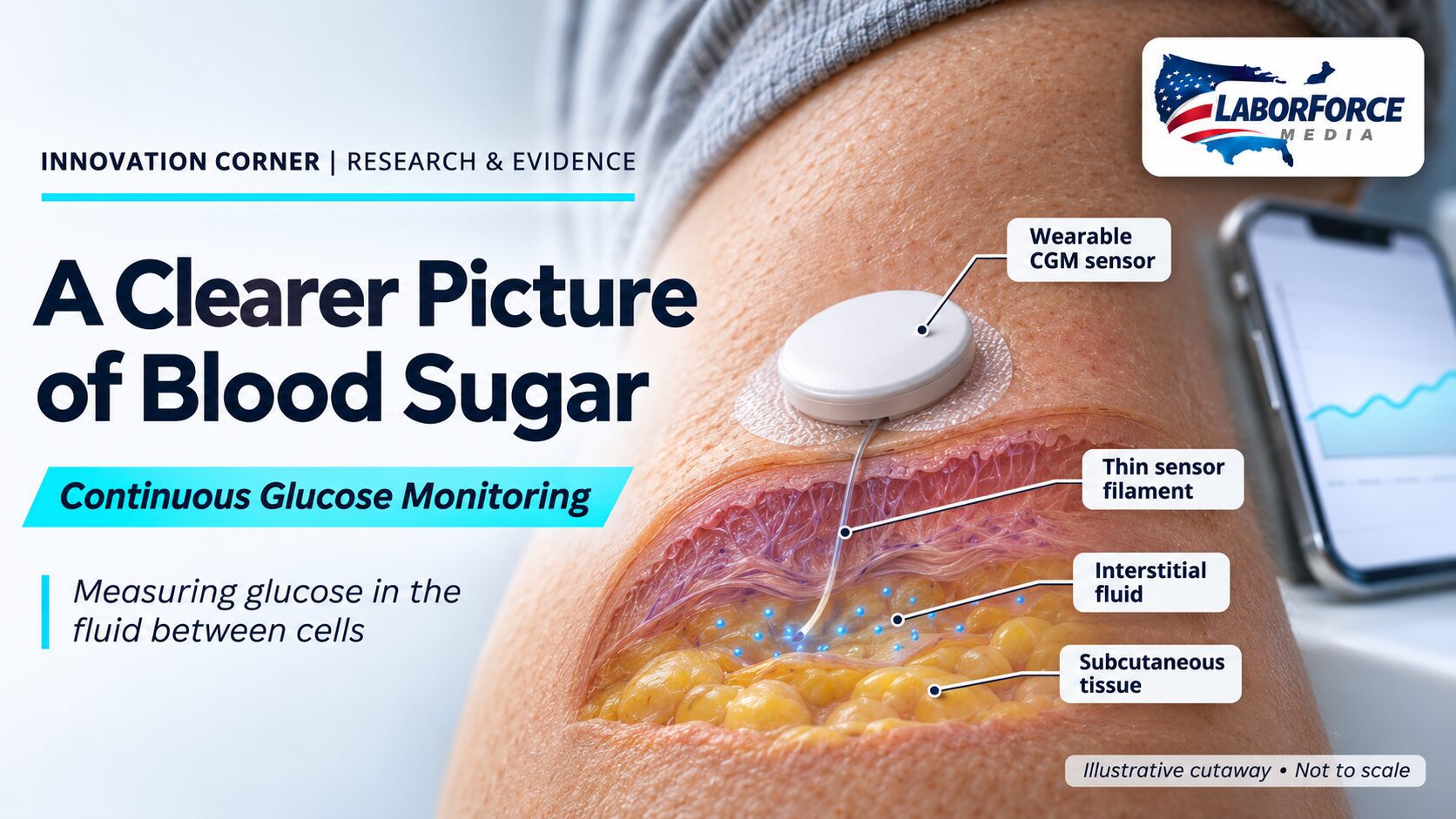
Continuous glucose monitoring, or CGM, helps fill those gaps. A small wearable sensor provides repeated glucose estimates throughout the day and night, revealing patterns that occasional finger-stick checks may miss.
Research is expanding our understanding of who may benefit—including people with type 2 diabetes who do not use insulin. For workers, families, and union health plans, the central question is how to turn that information into useful, accessible care.
What Does a CGM Actually Measure?
A CGM uses a sensor placed under the skin to estimate glucose in the fluid between cells. Depending on the system, readings appear on a compatible smartphone or separate receiver. Some devices provide alerts when glucose rises above or falls below selected thresholds.
Unlike an A1C test, which reflects average blood sugar over several months, CGM shows daily movement: where glucose is heading, how quickly it is changing, and how long it stays within a target range.
These readings have limitations. Glucose in tissue fluid can lag behind blood glucose, especially during rapid changes. Users may still need a finger-stick check when symptoms and sensor readings do not match, following their device’s instructions. [1]
What the Research Shows
The evidence goes beyond the appeal of seeing more data.
In the MOBILE randomized clinical trial, published in JAMA in 2021, researchers studied 175 adults with type 2 diabetes using basal insulin without mealtime insulin. After eight months, average A1C declined from 9.1% to 8.0% in the CGM group, compared with 9.0% to 8.4% among participants using a blood glucose meter.
Participants using CGM also spent more time within the study’s target glucose range of 70–180 mg/dL: 59% of the day versus 43% in the comparison group. These findings support CGM use in this population; they do not establish identical benefits for everyone with diabetes. [2]
Research has also examined people who do not use insulin. The IMMEDIATE trial compared intermittently scanned CGM plus diabetes self-management education with education alone in adults taking noninsulin diabetes medications. At 16 weeks, the CGM group spent approximately 2.4 additional hours per day within the target range, with a modest additional A1C reduction. Education was part of both groups’ care—a reminder that technology works within a broader treatment approach. [3]
More recently, a randomized trial published online in the New England Journal of Medicine in October 2026 studied adults with type 2 diabetes who were not using insulin. Over 26 weeks, average A1C fell from 8.8% to 7.2% with CGM, compared with 8.7% to 8.0% with routine care. The adjusted between-group difference was 0.9 percentage points. Dexcom funded the study, a relevant consideration when evaluating the evidence. [4]
These studies demonstrate improvements in glucose management over months. They do not establish that every CGM program prevents hospitalizations, produces long-term savings, or benefits people without diabetes.
Why This Matters for Working America
Glucose management takes place within real schedules and responsibilities.
A driver may have limited opportunities to stop. A healthcare worker may struggle to take a predictable meal break. A construction worker’s physical activity may vary substantially across the week.
CGM information can give patients and clinicians a clearer basis for discussing those circumstances. The practical opportunity is to connect patterns with an individualized care plan, with guidance that helps people understand what deserves attention.
The American Diabetes Association’s 2026 Standards of Care recommend CGM for people with diabetes using insulin, for certain noninsulin treatments that can cause low blood sugar, and when CGM otherwise helps management. Device selection should reflect individual needs, preferences, and circumstances. The guidance also emphasizes education and reliable access to supplies. [5]
Companies and Programs Putting CGM Into Practice
The CGM landscape includes device manufacturers, clinical care programs, and consumer platforms. Their offerings serve different purposes, and availability varies.
Dexcom develops CGM systems, including its G7 products. It also offers Stelo, an over-the-counter glucose biosensor intended for adults who do not use insulin. These products have different indications and capabilities; an over-the-counter option should not be assumed to meet every diabetes-management need.
Abbott’s FreeStyle Libre family includes CGM systems that provide glucose information through compatible devices and software. Features, approved uses, and eligibility vary by model.
Omada Health includes CGMs among the connected devices used in its virtual diabetes program. Its member resources describe connections with Abbott FreeStyle Libre systems. Device availability depends on program design and member eligibility.
Twin Health incorporates continuous glucose monitoring into its metabolic-health approach alongside other connected devices and care-team support. Its sensor guide explains pairing a Dexcom CGM with the Twin app.
Vida Health includes CGMs among devices that may be available to eligible members. Its support resources describe obtaining and using Dexcom G7, with availability dependent on health plan coverage and program eligibility. Vida also supports connecting Dexcom accounts so providers can review glucose information. According to its connection instructions, readings sync in the background rather than appearing in the member-facing Vida app.
Virta Health provides guidance for members using personal CGMs. Its resources explain that personal devices may require manual recording or separate data-sharing arrangements, and that supply and technical support depend on whether Virta provided the device. Supporting a member who uses CGM is different from universally supplying an integrated CGM benefit.
Levels offers a consumer metabolic-health platform that connects with compatible glucose sensors. Its resources describe connecting personal sensors and using Stelo subscriptions. Consumer insight services should be distinguished from clinician-directed diabetes treatment.
These examples illustrate different approaches. They are not a ranking or evidence that the programs deliver equivalent outcomes.
Questions Union Health Plans Should Ask
For trustees and benefit leaders, evaluating CGM requires looking beyond the sensor:
- Who is eligible, and what does the member pay?
- Who teaches members to use and interpret the device?
- Who reviews concerning patterns and coordinates clinical follow-up?
- What happens when a sensor fails or supplies are interrupted?
- How are personal health information and consent protected?
- Which outcomes are measured, and how are program claims supported?
For members, a useful starting question is: “Would CGM help me manage my diabetes, and what support comes with it?”
Key Takeaways
- CGM reveals patterns between individual blood sugar checks.
- Randomized trials show benefits for selected groups with type 2 diabetes, including some people not using insulin.
- Education, clinical guidance, and dependable supplies matter alongside the device.
- Manufacturers, clinical programs, and consumer platforms serve different purposes.
- Meaningful innovation combines useful information with affordable, practical care.
Continuous glucose monitoring offers a clearer view of daily diabetes management. Its greatest promise is helping people and their care teams turn that information into decisions that fit their lives.
Learn more about diabetes types, risk factors, and screening conversations.
This article provides general education. Device selection and treatment decisions should be made with a qualified healthcare professional.
Research and References
- National Institute of Diabetes and Digestive and Kidney Diseases. Continuous Glucose Monitoring.
- Martens T, Beck RW, Bailey R, et al. Effect of Continuous Glucose Monitoring on Glycemic Control in Patients With Type 2 Diabetes Treated With Basal Insulin: A Randomized Clinical Trial. JAMA. 2021;325(22):2262–2272. doi:10.1001/jama.2021.7444.
- IMpact of flash glucose Monitoring in pEople with type 2 Diabetes Inadequately controlled with non-insulin Antihyperglycaemic ThErapy (IMMEDIATE): A randomized controlled trial. Diabetes, Obesity and Metabolism. 2023. doi:10.1111/dom.14949.
- Continuous Glucose Monitoring in Non–Insulin-Treated Type 2 Diabetes. New England Journal of Medicine. 2026;395:1717–1727. Published online October 14, 2026. doi:10.1056/NEJMoa2608571.
- American Diabetes Association Professional Practice Committee. Diabetes Technology: Standards of Care in Diabetes—2026. Diabetes Care. 2026;49(Supplement 1).
Company descriptions are based on the official product and program resources linked above. Eligibility, features, and coverage may change.