



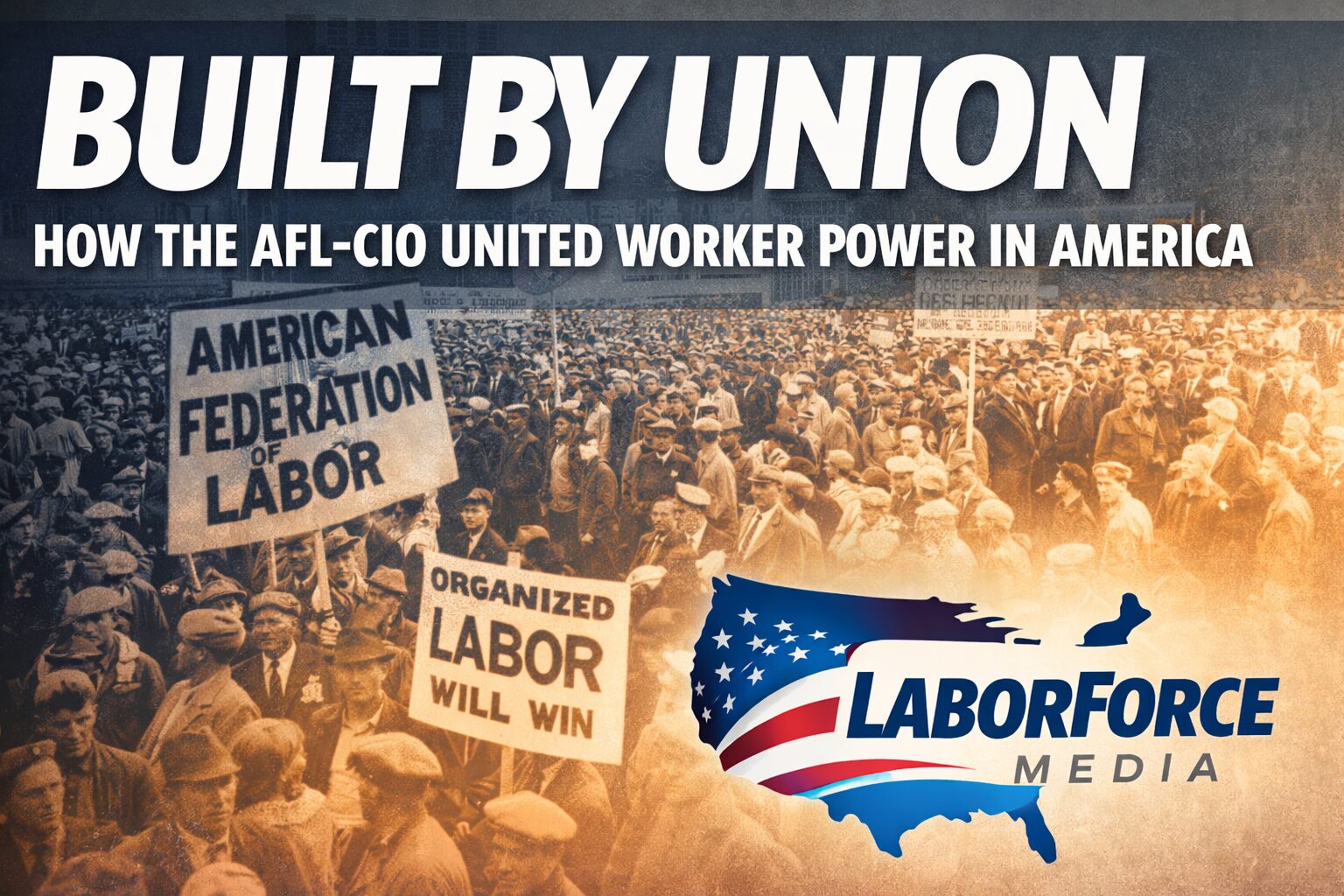
LaborForce Media | May 2026 | This issue includes a special focus on the AFL-CIO and its impact on American labor.
Before there were labor hashtags, viral walkouts, and national organizing campaigns, there was a federation built to bring workers together across trades, industries, and regions. This is the story of how the AFL-CIO became one of the most important forces in American labor history.
When most people hear the words “labor union,” they picture one workplace, one contract, or one strike. But the AFL-CIO is different. It is not a single union. It is a federation, a national alliance of unions that chose to stand together because they believed workers would be stronger united than divided. Today, the AFL-CIO describes itself as a democratic federation of 65 national and international unions representing nearly 15 million working people.
That scale did not happen overnight.
To understand the AFL-CIO, you have to go back to a time when work in America was often dangerous, exhausting, and unstable. In the late 1800s, industrial growth was transforming the country, but workers were often left with long hours, low wages, and little protection. In 1886, the American Federation of Labor, or AFL, was founded. The Library of Congress notes that the AFL grew out of an earlier federation and was formally founded on December 8, 1886.
The AFL focused mainly on skilled trades. Its approach was practical and disciplined: organize workers by craft, bargain for better wages and conditions, and build durable unions. That model gave many workers a voice, but it did not fully fit the new industrial economy that was rising in the early 20th century. Massive factories were filled with workers doing different jobs under one roof, and many of them did not fall neatly into a single craft category.
That tension helped spark the next chapter.
In 1935, a new labor force began to take shape inside the AFL: the Committee for Industrial Organization. Cornell’s labor archives explain that it was formed by union leaders who were frustrated with the AFL’s reluctance to commit fully to industrial unionism. They wanted to organize entire industries, not just separate crafts. By 1938, that movement had broken away and become the Congress of Industrial Organizations, or CIO.
The timing mattered. In the same year that the CIO was formed as a committee, Congress passed the National Labor Relations Act, also known as the Wagner Act. The NLRB says the law made clear that workers in the private sector had the right to organize, join unions, and bargain collectively. The National Archives likewise notes that President Franklin Roosevelt signed it on July 5, 1935, and that it established the National Labor Relations Board.
That legal protection helped open the door to a new era of labor organizing.
The CIO became known for organizing workers in large industries such as auto and steel. It helped bring union power to workers who had often been ignored or shut out before. In plain terms, the AFL and the CIO represented two different organizing philosophies born from two different eras of work in America. One was rooted in skilled crafts. The other was built for mass industry. Both mattered. Both changed the country. And eventually, both recognized that competing against each other weakened labor as a whole.
So in 1955, they merged.
The AFL-CIO’s own labor history timeline states that in 1955 the AFL and the CIO merged, with George Meany becoming president. That merger brought together labor organizations with different cultures, histories, and strategies into one larger federation.
That moment is one of the biggest turning points in American labor history.
It mattered because the merger sent a message: if employers were growing larger, national, and more organized, labor had to do the same. Workers could still belong to their own unions, with their own traditions and leadership, but they would now have a bigger umbrella organization to coordinate strategy, advocate for labor rights, and represent the broader interests of working people.
The AFL-CIO did not just try to grow union power at the bargaining table. It also became part of larger fights over democracy, fairness, and civil rights. The federation’s history timeline notes that in 1965 it formed the A. Philip Randolph Institute, and its labor history page on A. Philip Randolph says he used his position in the merged AFL-CIO to push for desegregation and greater respect for civil rights inside the labor movement and beyond it.
That is an important part of the story, especially for younger readers.
Labor history is not just about wages and contracts. It is also about who got included, who got excluded, and who fought to widen the circle. The labor movement has had moments of courage and moments of contradiction. Some unions opened doors. Others were slower to do so. But over time, labor became one of the places where working people pushed for broader dignity on the job and in public life.
The AFL-CIO has also kept evolving. Its current leadership page says Liz Shuler is president, making her the first woman leader of the AFL-CIO, and Fred Redmond serves as secretary-treasurer. The federation says it represents nearly 15 million workers through 65 unions.
That matters because today’s labor movement does not look exactly like the labor movement of 1955. It includes teachers, nurses, electricians, transportation workers, service workers, public employees, factory workers, communications workers, and many more. It also faces new questions: What does union power look like in the age of AI? What happens when workplaces become more digital, more fragmented, or more remote? How do workers organize in industries that barely existed a generation ago?
The AFL-CIO is trying to answer some of those questions in real time. Its website highlights current work on issues ranging from organizing to technology and worker protections, showing that the federation is still trying to serve as a national voice for labor in a changing economy.
So why start this series here?
Because the AFL-CIO helps explain the central idea of union history in America: workers are strongest when they act together, but “together” has never been simple. It has taken decades of organizing, disagreement, reform, merger, and reinvention to build the labor movement we know today.
The AFL-CIO is not the whole labor story. But it is one of the clearest windows into it.
It shows how labor moved from scattered job-site struggles to a national movement. It shows how workers built institutions, not just protests. And it shows that labor history is not dead history. It is living history, still shaping what work means in America.
At LaborForce Media, that is exactly why we are telling these stories.
Because if you want to understand where unions are going, you have to understand what built them.
Subscribe to Built by Union, LaborForce Media’s ongoing series on the organizations, leaders, workers, and turning points that shaped America’s labor movement.
Follow LaborForce Media on Substack https://substack.com/@laborforcemedia
Tags: