




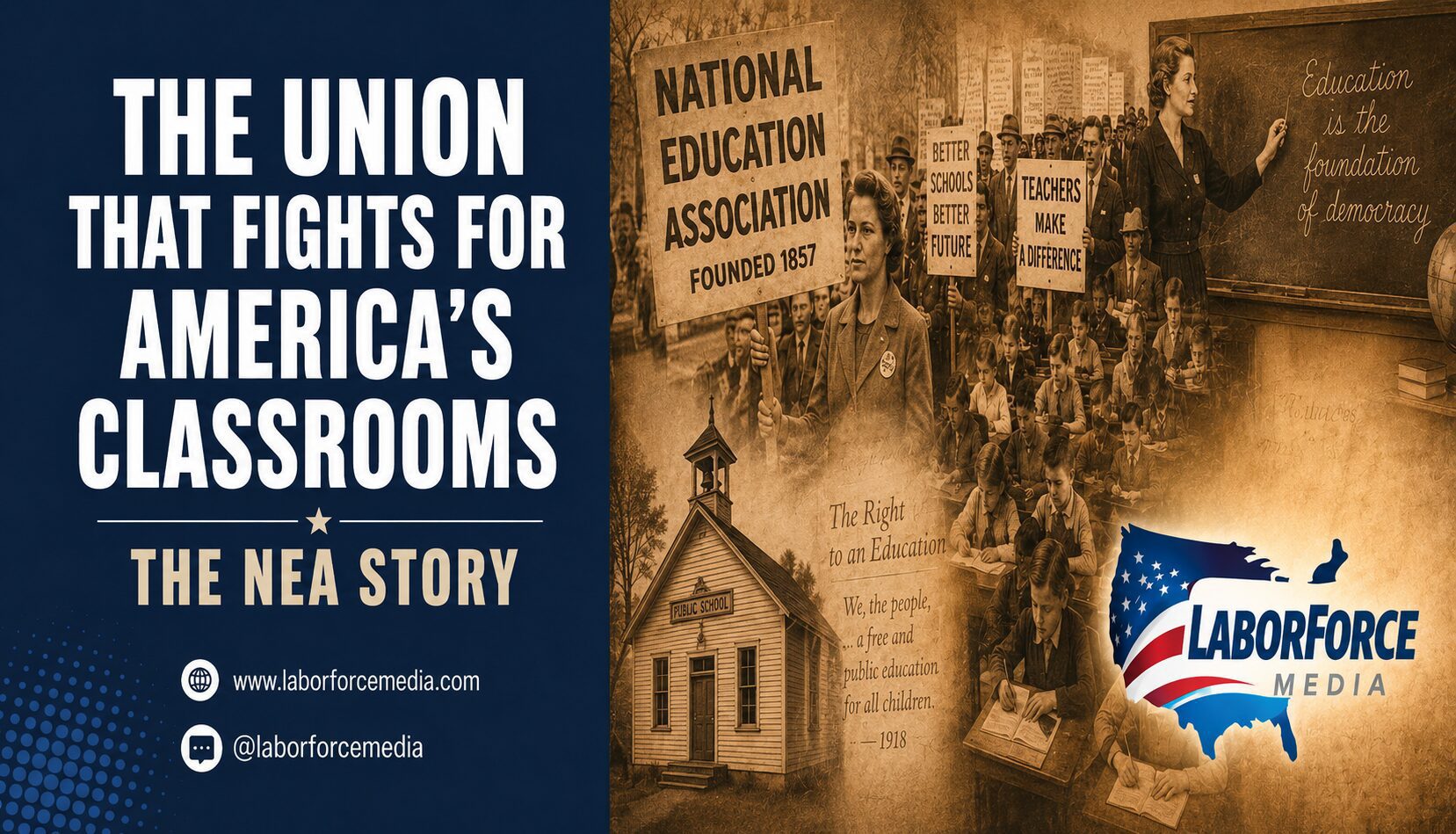
LaborForce Media | May 8, 2026. In this story, we take a closer look at The Union That Fights for America’s Classrooms: The NEA Story.
Walk into any classroom in America and you can feel the stakes immediately.
There is the teacher trying to reach twenty-five or thirty students at once. There is the child who came to school hungry. There is the student who needs extra support, the family worried about safety, the counselor carrying more cases than anyone should, and the school staff member who knows every child by name but is rarely the first person mentioned when people talk about education.
Public education is one of the biggest promises this country makes to its people: that every child, no matter their ZIP code, income, background, language, or family situation, deserves the chance to learn.
But that promise has never protected itself.
It has required educators to organize, speak up, negotiate, advocate, and keep reminding America that classrooms do not run on slogans. They run on people, resources, time, safety, trust, and respect.
That is where the story of the National Education Association begins.
The National Education Association, known as the NEA, traces its roots back to 1857, when educators came together in Philadelphia to form what was then called the National Teachers Association. The organization later became the National Education Association in 1870. Today, the NEA describes itself as made up of more than 3 million educators, students, activists, workers, parents, and community members committed to public education and opportunity for all students.
But to understand the NEA, we have to go back to a time when teaching looked very different.
In the 1800s, many American children were educated in one-room schoolhouses. Teachers often worked in isolation, with few protections, limited pay, little professional support, and almost no voice in education policy. The idea that teachers should help shape the future of schools was not yet widely accepted.
At the time, public education itself was still being built. Communities were debating who should have access to schooling, how schools should be funded, and what role education should play in a democracy. Teachers were expected to carry out the mission, but they were not always treated as professionals with expertise.
The early NEA grew out of that tension.
Educators understood something basic: if the people closest to students had no voice, then public education would always be designed from too far away. The classroom would be shaped by politics, budgets, and decisions made by people who did not always understand what children and teachers needed every day.
Over time, the NEA became more than a professional association. It became a national voice for educators and public schools.
After the Civil War, the country faced the enormous task of Reconstruction. Education was central to that effort. The NEA’s own history describes educators teaching newly freed people of all ages, with grandparents and grandchildren learning side by side. Public education was not only about reading and math. It was about citizenship, dignity, freedom, and participation in American life.
That is an important part of the NEA story. The fight for public education has always been connected to the fight over who gets included in the American promise.
As the country changed, so did schools. The rise of cities, industrial work, immigration, child labor reforms, and the growth of high schools all changed what Americans expected from public education. Schools became a central institution in community life. They were places where children learned, but also places where families connected to opportunity.
The NEA pushed into that national conversation.
In 1892, the organization created the “Committee of Ten,” a group that recommended a program of instruction for secondary schools. That work helped shape debates about what high school education should look like in America.
That may sound technical, but it mattered. It showed that educators were not just asking for better treatment. They were saying: we have something to contribute to the design of public education itself.
By the 20th century, the NEA was part of the broader growth of organized labor and professional advocacy. The organization’s history is different from many industrial unions because it began as a professional education association. But as the needs of educators changed, and as public employees began fighting for collective bargaining rights, the NEA became more directly connected to labor power.
For teachers, the issues were never only wages.
Pay mattered, of course. It still does. But educators were also fighting for smaller class sizes, safer schools, planning time, due process, benefits, retirement security, classroom resources, and respect for professional judgment. Those issues affect teachers, but they also affect students.
A teacher without enough planning time cannot give students the feedback they deserve. A school without enough counselors cannot meet the mental health needs of children. A district that cannot retain experienced educators loses knowledge, stability, and trust. A classroom without basic supplies sends a message to children about how much society values them.
That is why teacher unions occupy such a unique place in the labor movement.
They negotiate for workers, but the workplace is a public institution. Their bargaining table is connected to families, taxpayers, school boards, state policy, and the future of communities.
This is also why teacher unions can become the center of political debate.
When schools face budget cuts, staffing shortages, curriculum fights, safety concerns, or debates over student services, educators are often on the front line. They see the impact first. They also take the criticism first.
The NEA has become one of the most visible organizations in those debates.
Today, NEA President Becky Pringle is described by the organization as a middle school science teacher with more than three decades of classroom experience. Princess R. Moss, the NEA vice president, is an elementary school music teacher from Virginia.
That leadership detail matters because it reflects something central to the NEA’s identity: the organization is built around educators who know schools from the inside.
The NEA’s reach is national, but its work is lived locally. State and local affiliates are the places where educators organize around their own district realities—contract negotiations, staffing needs, safety concerns, school funding, professional development, and student support.
For LaborForce Media readers, this history is especially important because education is not separate from the larger world of work. Schools are workplaces. Educators are workers. School support staff are workers. Parents depend on schools to be stable, safe, and strong so they can work and provide for their families.
When public schools struggle, working families feel it quickly.
When there are teacher shortages, children lose consistency. When bus routes are understaffed, parents miss work. When school nurses, counselors, paraprofessionals, and special education teams are stretched thin, families are left to fill the gaps. When educators burn out and leave, communities lose trusted professionals.
That is why the NEA story is not only a teacher story. It is a labor story, a family story, and a community story.
There are fair debates to have about education policy. People disagree about budgets, testing, curriculum, school choice, accountability, and the role of unions. Those debates are not going away.
But history gives us a clear lesson: public education works best when the people closest to students have a real voice.
Teachers know what happens when a child falls behind. Counselors know when anxiety and depression are rising. School nurses know when families are skipping care. Paraprofessionals know which students need more support than the system is giving them. Bus drivers, cafeteria workers, school secretaries, and custodians often see things no spreadsheet will ever capture.
The NEA’s long fight has been to make sure those voices are not treated as an afterthought.
From one-room schools to modern classrooms, from Reconstruction to today’s debates over staffing and student support, the NEA’s story is a reminder that education is not just a service. It is a public good. It is also labor.
And when educators organize, they are not only asking for a better contract.
They are asking America to take its own promise seriously.
Teacher unions are not just about contracts. They are about the future of public education.
Call to Action:
Share this with an educator, school counselor, school staff member, parent, or public-school supporter who believes strong schools are the foundation of strong communities.
Union Supporter Spotlight
Strong schools depend on strong educators, and strong educators also need support outside the classroom. That is especially true for teachers, school counselors, nurses, paraprofessionals, and school staff who are returning to work after welcoming a new baby.
This is where family-centered benefits can make a real difference. Happiest Baby, the company behind SNOO, focuses on infant sleep support and tools designed to help new parents during one of the most demanding stages of family life. Through its employee benefit program, Happiest Baby says better infant sleep can help parents return to work more focused, resilient, and productive, while also supporting more equitable family benefits.
For educators with newborns, that kind of support matters. A teacher walking back into the classroom after parental leave is not just returning to a job. They are returning to students, lesson plans, emotional demands, early mornings, and the daily responsibility of helping children learn. Practical family benefits that support rest, recovery, and the transition back to work can help educators feel seen not only as professionals, but as parents and whole people.
LaborForce Media celebrates organizations that recognize the connection between family stability and workforce strength. When companies support working parents, they are also supporting the classrooms, schools, and communities those parents serve.
Key Takeaways
- The National Education Association began in 1857, when educators gathered in Philadelphia to create a national voice for public education.
- The NEA became the National Education Association in 1870, growing from the National Teachers Association into a broader organization representing educators and public education.
- The NEA story is about more than teacher contracts. It is about educator voice, classroom resources, student support, and the future of public education.
- Teacher unions are deeply connected to working families because strong public schools support children, parents, communities, and the broader workforce.
- NEA leaders Becky Pringle and Princess Moss both come from classroom education backgrounds, reinforcing the organization’s identity as a voice led by educators.
- Family-supportive benefits, including tools that help new parents manage the return-to-work transition, can play a meaningful role in helping educators stay strong for their students.
Sources
- National Education Association, “History of NEA”
- National Education Association, “NEA & the U.S. Labor Movement”
- National Education Association, “Our Leaders”
- Happiest Baby, “SNOO Employee Benefit Program”
Follow LaborForce Media on Substack: https://substack.com/@laborforcemedia
Tags: