



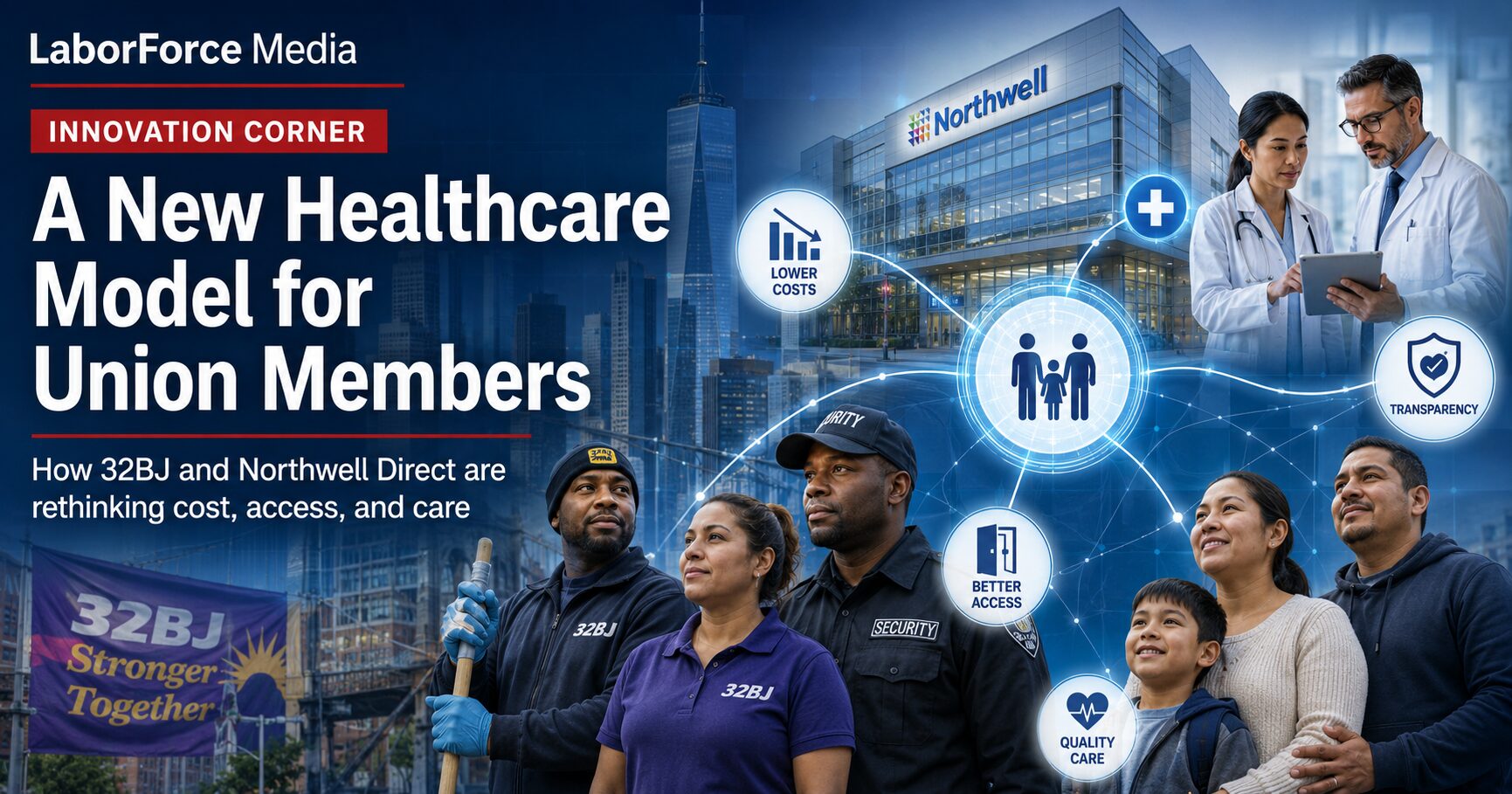
LaborForce Media | Innovation Corner | May 2026. This edition explores How 32BJ and Northwell Direct Are Rewriting the Cost Model.
Healthcare affordability has become one of the most urgent economic issues facing working families, employers, and union benefit funds. For unions, the question is no longer only how to protect benefits at the bargaining table. It is also how to redesign the healthcare purchasing model itself. In fact, How 32BJ and Northwell Direct Are Rewriting the Cost Model is now a key example for labor leaders studying new approaches.
That is what makes the new agreement between the 32BJ Health Fund and Northwell Direct worth watching. Ultimately, the initiative demonstrates How 32BJ and Northwell Direct Are Rewriting the Cost Model in real time.
The 32BJ Health Fund, which serves building service workers and their families, has entered into what Northwell and 32BJ describe as the largest direct healthcare contract of its kind in the United States. The agreement gives roughly 170,000 participants access to Northwell Direct’s healthcare network while changing the way the Fund pays for care. Instead of relying on the traditional model with multiple administrative layers between the payer and the provider, the Fund and Northwell Direct will manage the relationship more directly.
That sounds technical, but the impact is practical: lower costs for the Fund, lower out-of-pocket costs for members, and a more transparent relationship between the people paying for care and the people delivering it. Notably, How 32BJ and Northwell Direct Are Rewriting the Cost Model has become a subject of discussion throughout the industry.
Under the agreement, the 32BJ Health Fund estimates it will save $46 million in the first year, or about 20 percent. Members using Northwell Direct providers are expected to see inpatient copays drop from $1,000 to $100, outpatient copays drop from $250 to $75, and copays for more than 12,000 Northwell providers drop from $40 to $0. Member out-of-pocket savings are estimated at approximately $5 million annually.
The agreement also preserves access to the existing Anthem network, meaning members are not being forced into a narrow replacement model. Instead, they gain a lower-cost preferred pathway through Northwell Direct while maintaining broader network access.
The innovation is not only in the discount. It is in the structure.
For years, healthcare costs have risen faster than wages and general inflation. KFF reported that average annual premiums for employer-sponsored family coverage reached $26,993 in 2025, with workers contributing an average of $6,850. Mercer separately reported that average employer-sponsored health insurance costs reached $17,496 per employee in 2025 and were expected to exceed $18,500 in 2026.
Those numbers matter to unions because healthcare costs often compete directly with wage increases, pension contributions, staffing investments, and other bargaining priorities. When healthcare becomes more expensive, the pressure does not disappear. It shows up somewhere else.
The 32BJ model attacks that pressure by using purchasing power differently. The Fund aggregates contributions from thousands of employers and uses that scale to negotiate directly with a major health system. According to Northwell and 32BJ, the agreement removes a layer of third-party administration, caps annual fee schedule increases at no more than 5 percent, and creates a direct administrative relationship between the Fund and Northwell Direct.
This is a major point for union health funds: innovation does not always mean a new app, a new wearable, or a new vendor. Sometimes innovation means redesigning the financial plumbing underneath the benefit.
The Fund also appears to be building from a broader strategy. Northeast Business Group on Health notes that 32BJ previously pursued other cost-management initiatives, including changes to hospital network strategy, pharmacy purchasing, and Centers of Excellence programs. In 2024, the Fund conducted a medical RFP that required finalists to have a signature-ready contract, creating more visibility and accountability before a deal was awarded. Above all, this sets an important precedent for How 32BJ and Northwell Direct Are Rewriting the Cost Model in today’s environment.
That is the real lesson: this did not happen by accident. It reflects a sophisticated, data-driven benefits strategy with members at the center.
What This Means for Unions
For unions and Taft-Hartley funds, the 32BJ-Northwell Direct agreement offers a possible blueprint. It shows that labor can be more than a defender of benefits; it can be an architect of better healthcare purchasing.
The opportunity is clear: use collective scale, claims data, member needs, and employer contributions to demand better pricing, better access, and better accountability from healthcare systems. Not every union fund will have the size of 32BJ, and not every market will have a Northwell Direct-style partner. But the principle travels: unions can evaluate direct contracting, Centers of Excellence, transparent pharmacy purchasing, preferred provider partnerships, and navigation models that lower costs without simply shifting the burden to members.
The takeaway for labor leaders is this: healthcare innovation should be a bargaining strategy, a benefits strategy, and a member-protection strategy. The future of union healthcare may depend on funds willing to ask a harder question—not just “How much will premiums rise?” but “Who is being paid, what value are they delivering, and can we build something better?”
Sources
-Business Wire / Northwell Health, “32BJ Health Fund and Northwell Direct Announce Largest Direct Healthcare Contract of its Kind in the Country,” Dec. 16, 2025.
-Becker’s Hospital Review, “Northwell launches direct healthcare partnership with 32BJ Health Fund,” May 11, 2026.
-Northeast Business Group on Health, “Breaking the Cost Curve: How 32BJ Health Fund and Northwell Direct Are Redefining Affordable Care.”
-KFF, “2025 Employer Health Benefits Survey,” Oct. 22, 2025.
-Mercer, “U.S. employers and workers will face affordability crunch as health insurance cost is expected to exceed $18,500 per employee in 2026,” Nov. 18, 2025.
Tags: