




Before AFSCME became one of America’s most important public service unions, it began with a basic question:
Should public jobs belong to political insiders, or should they belong to qualified people who serve the public?
That question may sound simple today, but in 1932, in the middle of the Great Depression, it mattered deeply. Government jobs were a lifeline. Families needed steady work. Communities needed stable public services. And public employees needed protection from political patronage — the old “spoils system,” where who you knew could matter more than how well you served.
That is where the story of AFSCME begins.
AFSCME, the American Federation of State, County and Municipal Employees, traces its roots to Madison, Wisconsin. In 1932, a small group of white-collar professional state employees formed the Wisconsin State Employees Association to defend and strengthen the civil service system. Their goal was not only to protect their own jobs. They wanted public employment to be based on merit, fairness, and service rather than political loyalty.
That beginning tells us a lot about AFSCME’s identity.
This was a union built around the idea that public service matters. It was not only about pay. It was about whether government could function fairly. It was about whether the people who maintain public systems would have stability, rights, and a voice.
Over time, that Wisconsin movement grew into a national union. AFSCME became a voice for state, county, and municipal workers — the people who keep public life running. They worked in government offices, hospitals, sanitation departments, public works, corrections, schools, libraries, transportation systems, parks, emergency services, and community programs.
Many were not famous. Most were not on television. But their work touched almost every American family.
That is the powerful truth behind AFSCME’s history: public service workers are often most visible when something goes wrong, but they are essential every day.
When roads are cleared, water systems work, hospitals stay open, parks are maintained, emergency calls are answered, and public offices serve residents, AFSCME members are often part of that work.
As AFSCME grew, it became part of the larger fight for public-sector collective bargaining. Public employees wanted the same core dignity other workers sought: fair wages, benefits, safe working conditions, due process, retirement security, and a real voice in the decisions that shaped their jobs.
But AFSCME’s story became larger than any one workplace.
It became part of the civil rights story of America.
The clearest example came in Memphis in 1968.
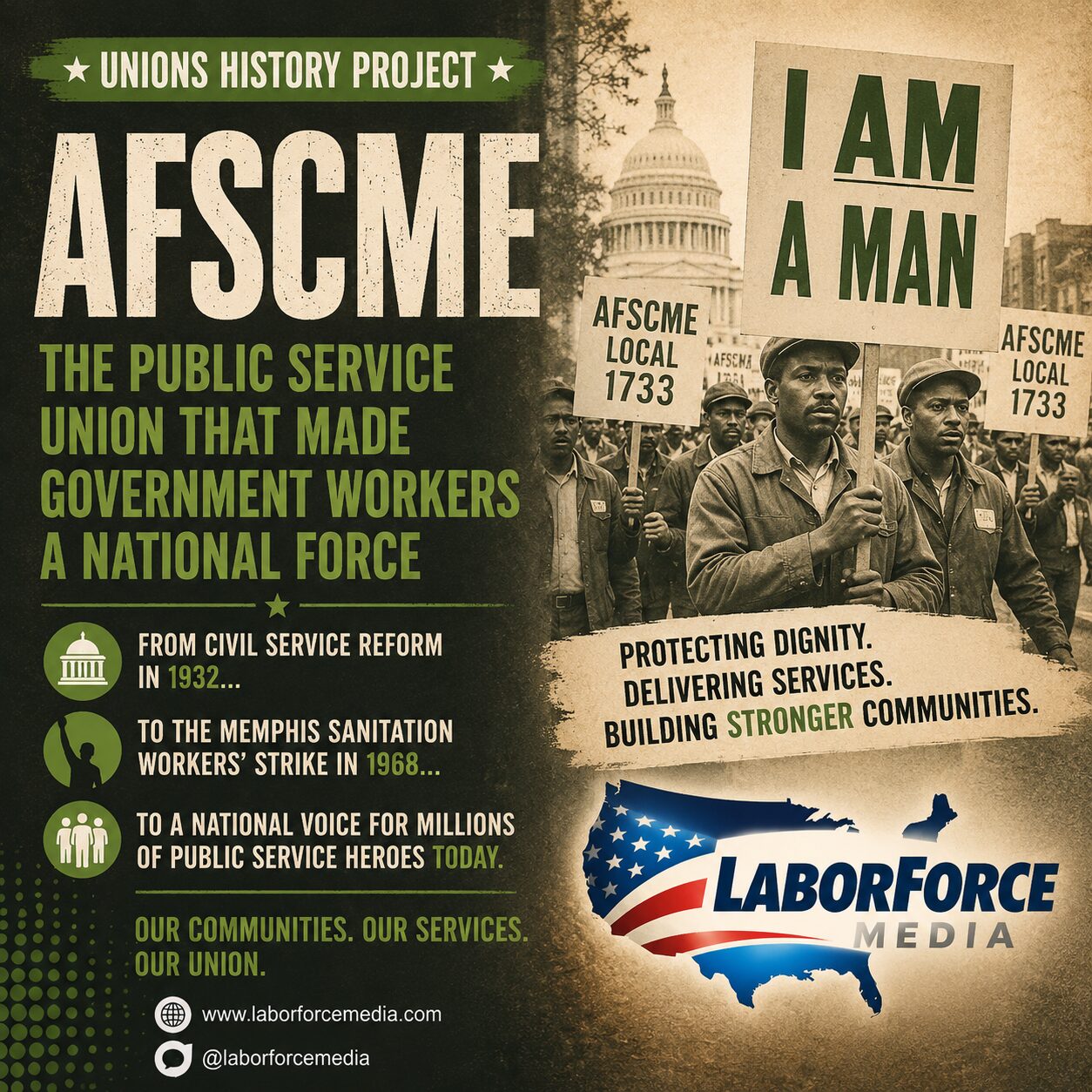
On February 1, 1968, two Memphis sanitation workers, Echol Cole and Robert Walker, were killed when they were crushed in a garbage truck during a rainstorm. Their deaths became a breaking point for Black sanitation workers who had long faced dangerous working conditions, low pay, discrimination, and a city government that refused to recognize their union.
On February 12, 1968, more than 1,300 sanitation workers went on strike. They demanded union recognition, safer conditions, better wages, a grievance process, and basic respect. Their signs carried a message that became one of the most powerful statements in labor and civil rights history: “I AM A MAN.”
AFSCME Local 1733 stood at the center of that fight. The strike drew national attention, and AFSCME International President Jerry Wurf came to Memphis in February, saying the strike could end only when the workers’ demands were met.
Dr. Martin Luther King Jr. came to Memphis to support the workers. On April 3, 1968, he gave his “I’ve Been to the Mountaintop” speech. The next day, he was assassinated. The strike ended on April 16, 1968, with union recognition and wage increases for the sanitation workers.
That moment forever connected AFSCME to one of the central lessons of American labor history: economic justice and civil rights are not separate struggles.
For the Memphis sanitation workers, the fight was about wages and safety. But it was also about human dignity. It was about being seen. It was about workers saying their labor mattered, their lives mattered, and their voice mattered.
That message still defines AFSCME.
Today, AFSCME describes its members as workers in hundreds of occupations who advocate for fairness in the workplace, excellence in public services, and opportunity for working families.
That broad membership is what makes AFSCME unique. It is not tied to one industry in the way some unions are. It is tied to public service itself.
AFSCME members may be corrections officers, nurses, sanitation workers, clerical workers, social service employees, school support staff, child care providers, public health workers, emergency dispatchers, or local government professionals. Different jobs, one shared mission: keeping communities functioning.
That is why AFSCME’s work is so connected to everyday life.
If public workers are underpaid, understaffed, or ignored, communities feel it. If experienced workers leave public service, services weaken. If public employees do not have a voice, the people who know where systems are breaking down are left out of the solution.
AFSCME’s history teaches that public workers are not background workers. They are public infrastructure.
The worker answering a county benefits question is part of the safety net. The sanitation worker keeping neighborhoods clean is part of public health. The corrections officer is part of public safety. The public hospital worker is part of community care. The child care worker helps working parents stay employed. The library worker helps keep knowledge open and accessible.
This is the story AFSCME has been telling since 1932.
Government works because people work.
Public service works because workers show up.
And democracy works better when the people serving the public have rights, dignity, and a voice.
From Madison to Memphis, from civil service protections to collective bargaining, from local government offices to public hospitals and sanitation departments, AFSCME’s history is a reminder that the work of public employees is the work that holds communities together.
The union began by defending fairness in public employment. It grew by organizing workers who wanted respect and a seat at the table. It became part of the civil rights movement because its members understood that dignity on the job is inseparable from dignity in life.
AFSCME’s story is not only a union story.
It is an American public service story.
And it continues wherever public workers stand together and say: our work matters, our communities matter, and we deserve to be heard.
Key Takeaways
- AFSCME began in 1932 in Madison, Wisconsin, when public employees organized to protect civil service from political patronage.
- The union grew into a national voice for state, county, and municipal workers across hundreds of public service occupations.
- AFSCME’s history is deeply connected to the 1968 Memphis sanitation workers’ strike and the civil rights movement.
- The Memphis strike showed that labor rights, safety, racial justice, and human dignity are deeply connected.
- AFSCME’s broader message is that strong public services depend on respected, protected, and empowered public workers.
Sources
- AFSCME, “History”
- AFSCME, “About AFSCME”
- AFSCME, “1968 Memphis Sanitation Workers’ Strike Chronology”
- Stanford Martin Luther King Jr. Research and Education Institute, “Memphis Sanitation Workers’ Strike”
- Swarthmore Global Nonviolent Action Database, “Memphis, Tennessee, sanitation workers strike, 1968”
- Wayne State University Walter P. Reuther Library, “AFSCME Local 1733: Memphis, Tennessee Records”
Follow LaborForce Media on Substack:
Tags: