




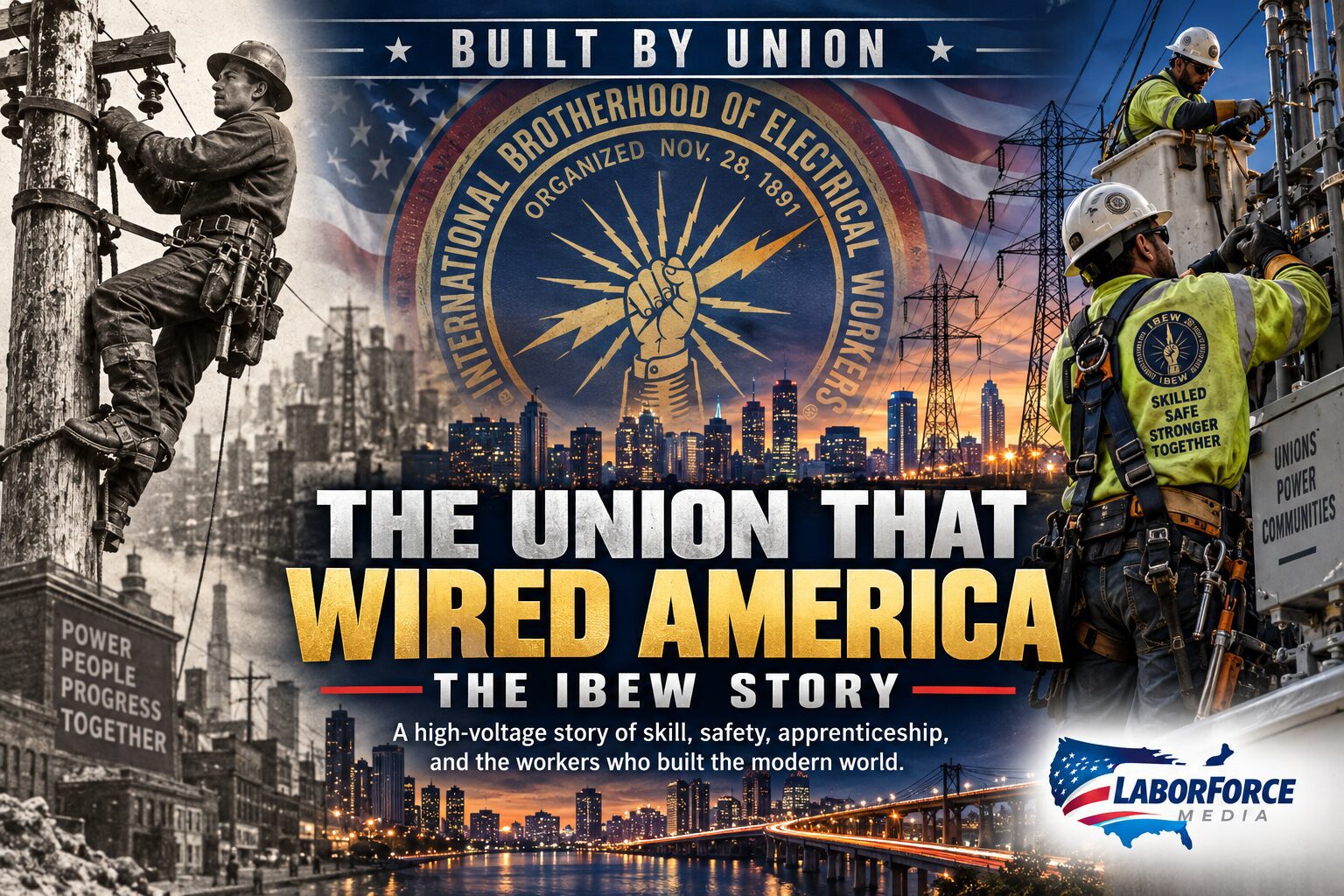
LaborForce Media | Union History | September 12, 2026
Long before electricity felt ordinary, working with it could be deadly.
Imagine climbing a wooden pole at night with primitive equipment, little protective gear, and thousands of volts running only inches from your hands. There were no modern bucket trucks, no digital testing systems, and no century of safety standards behind you.
For the electrical workers who helped wire America in the late 19th century, danger was part of the job.
And that danger became one of the reasons they organized.
Today, the International Brotherhood of Electrical Workers, or IBEW, represents approximately 901,000 active members and retirees across the United States and Canada. Its members work in construction, utilities, telecommunications, broadcasting, manufacturing, railroads, and government.
But its story began much smaller.
In 1891, just 10 electrical workers representing 286 members gathered in St. Louis, Missouri, for the first convention of what was then called the National Brotherhood of Electrical Workers.
They were trying to solve a basic problem:
How do you build a future when the work building that future can kill you?
Electricity Was New. The Risks Were Real.
At the end of the 19th century, electricity was transforming American life.
Cities were installing electric lights.
Telephone and telegraph systems were spreading.
Factories were beginning to use electric machinery.
Utility networks were expanding.
To most Americans, electricity looked like progress.
To electrical workers, it also looked like exposed wires, dangerous poles, improvised equipment, and long days around high voltage.
IBEW has described the dangers of that period starkly: in its earliest days, as many as one out of every two linemen could be disabled or killed on the job.
That is difficult to imagine today.
But it explains why safety became part of the union’s identity from the beginning.
The man most closely associated with the founding of IBEW was Henry Miller, a traveling lineman who moved from city to city working in the growing electrical industry.
As he traveled, Miller met workers facing the same dangers and many of the same problems.
He began organizing them.
In 1891, Miller helped bring the first delegates together in St. Louis. They met in humble surroundings with very little money and no guarantee that their idea would survive.
But it did.
And Miller became the union’s first president.
The Founder Did Not Escape the Danger
The tragedy in Henry Miller’s story explains just how real those early workplace risks were.
On the night of July 10, 1896, Miller was working in Washington, D.C., repairing a lighting circuit damaged by a storm.
While on a utility pole, he came into contact with a live wire carrying 2,200 volts.
The shock threw him from the pole.
He died several hours later.
Miller was only 38.
The man who had helped organize electrical workers partly because of the dangers of the trade was killed by the very danger he had spent years confronting.
His death gives the early IBEW story a human face.
This was not an abstract debate over workplace regulations.
People were dying.
Workers needed training.
They needed safer practices.
They needed standards.
And they needed enough collective power to insist that safety mattered.
That principle remains deeply embedded in IBEW today.
Ten Workers, One Big Idea
The founding convention in St. Louis was not impressive by modern standards.
Ten delegates.
A few hundred represented workers.
No giant headquarters.
No national political operation.
No apprenticeship system.
No nearly million-member organization.
IBEW’s historical records even describe the founders as worried by how small the turnout was.
But they had one advantage:
They understood where the country was headed.
America was going to electrify.
Someone would have to build that system.
Someone would have to maintain it.
And the people doing that work needed a way to protect their interests as the industry grew.
That is one of the most important lessons in union history.
Sometimes workers organize not because an industry is disappearing.
Sometimes they organize because an industry is about to explode.
Wiring a Modern Nation
Over the decades that followed, electricity moved from novelty to necessity.
Electrical workers helped wire homes.
Factories.
Office buildings.
Hospitals.
Schools.
Transit systems.
Power plants.
Communication networks.
Industrial facilities.
Entire cities.
The union expanded with the industry.
What began as the National Brotherhood of Electrical Workers eventually became the International Brotherhood of Electrical Workers as the organization expanded into Canada. IBEW’s publication history notes that the organization adopted the IBEW name in 1899.
That international reach reflected something bigger.
The electrical industry was no longer a small collection of local projects.
It was becoming infrastructure.
And infrastructure requires skilled workers.
Skill Became Power
Electrical work is different from many jobs because mistakes can be catastrophic.
A poorly installed circuit is not simply an inconvenience.
It can cause fires.
Equipment failure.
Injury.
Electrocution.
That reality helped shape another defining feature of IBEW:
training.
Over time, the union increasingly connected craftsmanship with worker power.
The idea was straightforward.
A strong union should not simply negotiate better wages.
It should help produce highly skilled workers whose training makes them valuable to employers, customers, and communities.
That philosophy eventually became one of IBEW’s most recognizable strengths.
Today, IBEW and the National Electrical Contractors Association, or NECA, jointly support the Electrical Training Alliance, which IBEW describes as the largest training and apprenticeship program in the electrical industry.
That partnership creates an unusual model.
Workers learn their trade through a combination of classroom instruction and real-world experience.
Contractors gain access to trained labor.
Apprentices build careers while developing technical expertise.
And the industry establishes standards for the people performing complex electrical work.
Apprenticeship: Learning While Building a Career
For a high school student deciding what comes next, this may be one of the most important parts of the IBEW story.
College is one path.
It is not the only path.
An electrical apprenticeship offers a different model:
Learn a skilled trade.
Train under experienced workers.
Earn while you learn.
Progress toward journeyman status.
Build skills that can travel with you for decades.
The IBEW-NECA training system includes roughly 270 training centers, and union leadership has described tens of thousands of people entering those centers each year.
That makes apprenticeship more than a union benefit.
It is a workforce-development system.
It also challenges an old stereotype about skilled trades.
Modern electrical work is not simply manual labor.
It requires math.
Technology.
Problem solving.
Reading plans.
Understanding codes.
Working with sophisticated systems.
Managing risk.
And continuously learning as technology changes.
Electricity Keeps Changing
That last point matters because the electrical industry Henry Miller knew barely resembles the electrical industry of today.
Consider what electrical workers now help build and maintain:
Data centers.
Electric vehicle charging systems.
Solar installations.
Wind energy.
Smart buildings.
Battery storage.
Advanced manufacturing.
Modern telecommunications systems.
Power-grid upgrades.
Rail and transportation systems.
Hospitals filled with electronic equipment.
And increasingly, the infrastructure needed to support artificial intelligence and cloud computing.
The world keeps electrifying in new ways.
And that means electrical workers keep learning new skills.
IBEW International President Kenneth W. Cooper has emphasized that the union represents far more than construction electricians, including workers in utilities, telecommunications, broadcasting, manufacturing, government, and railroads.
That breadth matters.
IBEW did not simply help wire the America of the past.
Its members are helping build the systems America will depend on next.
From Apprentice to International President
Kenneth Cooper’s own career illustrates another recurring theme in union history.
He started as an apprentice.
Cooper began his IBEW career in 1985 with Local 688 in Mansfield, Ohio, completing a four-year apprenticeship to become a journeyman wireman. He later served as steward, vice president, president, business manager, and in other leadership roles before becoming IBEW International President in 2023.
That journey matters because it reinforces the apprenticeship model in a very tangible way.
The person leading the union once stood where every new apprentice stands:
Learning the trade.
Taking instruction.
Working under experienced journeymen.
Building skills one job at a time.
IBEW’s International Secretary-Treasurer, Paul A. Noble, also came through the trade and completed an apprenticeship after beginning his career in telecommunications.
That kind of career path gives union leadership a direct connection to the work itself.
Safety Is Still the First Standard
Electrical work today is safer than it was in Henry Miller’s time.
But safe does not mean risk-free.
Lineworkers still restore power during storms.
Construction electricians still work around energized systems.
Utility workers still climb, repair, and maintain critical infrastructure.
IBEW continues to make safety a central part of its identity. In a 2026 message to members, Cooper described safety as the union’s top priority and noted that linework remains one of North America’s most dangerous occupations even though fatalities have fallen dramatically since IBEW’s founding.
That connection between history and modern safety is important.
Training is not just about becoming better at a job.
It can determine whether someone gets home safely.
The New Energy Economy
The next chapter in IBEW history may be as important as the first.
North America is entering another period of massive electrical expansion.
The power grid needs modernization.
Electric vehicles require charging infrastructure.
Data centers require enormous amounts of electricity.
Renewable-energy projects require construction and maintenance.
Factories are becoming more automated and electrified.
Artificial intelligence requires computing infrastructure that ultimately depends on power.
That means demand for skilled electrical workers is not disappearing.
It is evolving.
And that puts IBEW in a familiar position.
More than 130 years ago, its founders saw a rapidly growing technology and understood that workers needed skill, standards, safety, and collective strength to build it responsibly.
Today, the technology is different.
The principle is not.
The Union That Wired America
It is easy to take electricity for granted.
Flip a switch.
Charge a phone.
Plug in a computer.
Walk into a hospital.
Ride an elevator.
Enter a data center.
Turn on an air conditioner.
The power is simply expected to be there.
But electricity does not arrive by magic.
People build the systems behind it.
People maintain them.
People repair them when storms knock them down.
People upgrade them when new technology demands more power.
And people train for years to do that work safely.
That is what makes the IBEW story so compelling.
It is not simply the history of a union.
It is the history of workers learning how to master one of the technologies that transformed modern civilization.
Built by Union
In 1891, 10 electrical workers gathered in St. Louis because they believed their trade needed something stronger.
Training.
Safety.
Standards.
Solidarity.
More than a century later, those ideas remain at the center of IBEW.
Today the union represents approximately 901,000 active members and retirees working across some of North America’s most important industries.
But the most powerful part of the story may still be the simplest.
Electricity helped build the modern world.
Electrical workers built the systems that made it possible.
And those workers organized to make sure progress included them too.
Why LaborForce Media Is Telling These Stories
Built by Union is LaborForce Media’s ongoing project documenting the workers, unions, skills, struggles, and breakthroughs that helped build America—and continue shaping the future of work.
For students and young workers considering what comes after high school, the IBEW story offers an especially important lesson:
A meaningful career does not have to follow only one path.
Apprenticeship can combine education, skilled work, mentorship, wages, and a career that evolves alongside technology.
And as America’s electrical infrastructure enters another period of major transformation, the people who know how to safely build and maintain it may be more important than ever.
Share this story with an apprentice, technical student, high school student, or anyone considering a future in the skilled trades.
And subscribe to Built by Union as LaborForce Media continues telling the stories behind America’s labor movement.
Sources
International Brotherhood of Electrical Workers, Our History & Museum
International Brotherhood of Electrical Workers, History and Structure of the IBEW
International Brotherhood of Electrical Workers, About IBEW
International Brotherhood of Electrical Workers, Our Leadership
International Brotherhood of Electrical Workers, Remembering Henry Miller
International Brotherhood of Electrical Workers, Construction & Maintenance
International Brotherhood of Electrical Workers, Honoring Our Linemen