




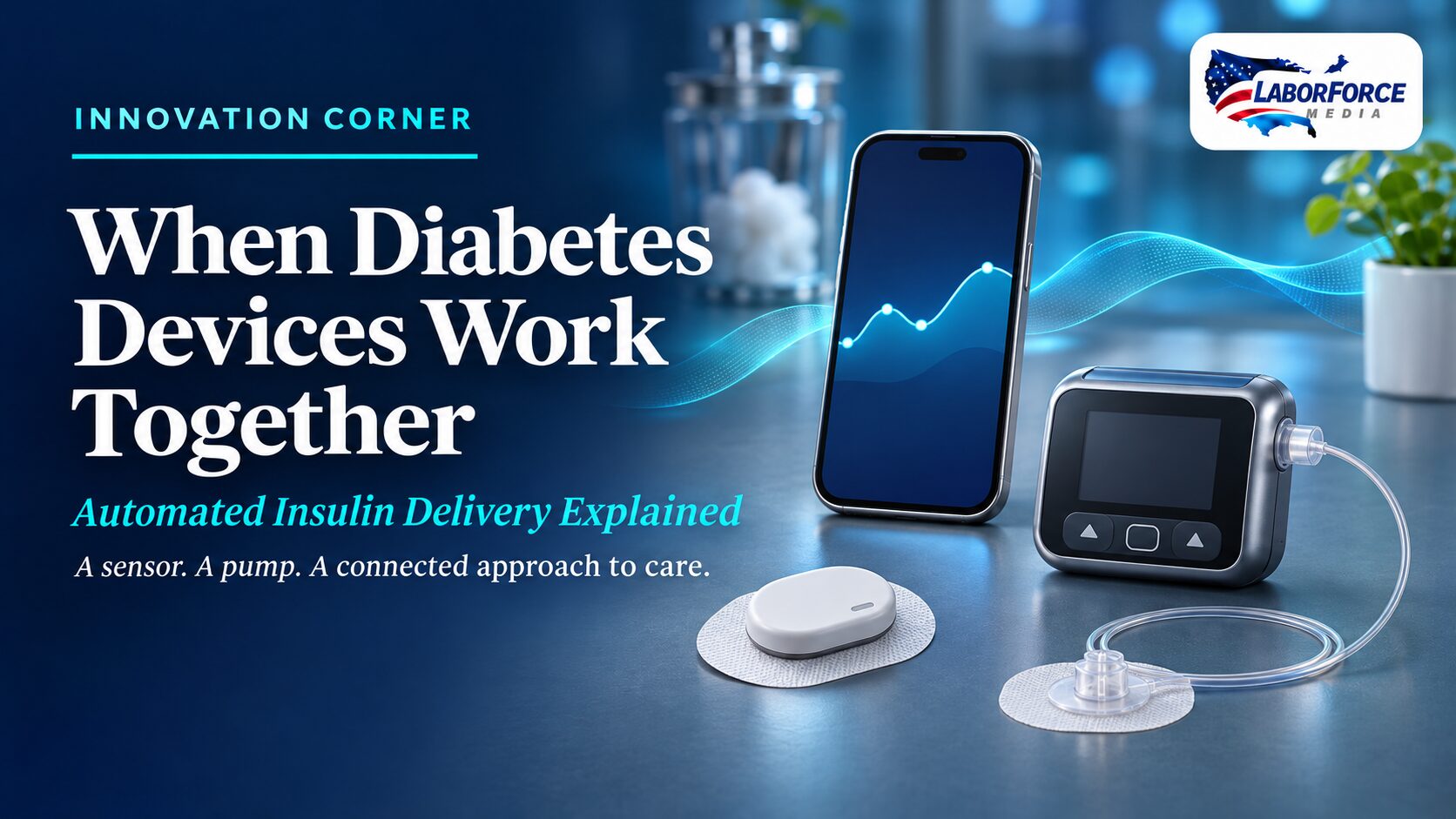
A sensor. A pump. A connected approach to care. Automated Insulin Delivery Explained: Diabetes Devices have paved the way for how diabetes technology can support daily management—and what users still need to do.
LaborForce Media | Innovation Corner | National Diabetes Awareness Month
For someone managing diabetes with insulin, the decisions keep coming: What is my glucose doing? How will lunch affect it? What happens when a physically demanding shift becomes an afternoon behind a desk?
Automated insulin delivery, or AID, connects glucose monitoring with insulin delivery to help manage some of those adjustments throughout the day and night.
The innovation lies in how the pieces communicate. A glucose sensor sends readings to software, which directs an insulin pump to adjust delivery. Research shows this approach can improve glucose management, with expanding options for people with type 1 diabetes and some adults with insulin-treated type 2 diabetes. But understanding what the technology handles—and what it still asks of the user—is essential. (NIDDK)
Three components, one connected system
An AID system brings together three functions:
| Component | What it does |
| Continuous glucose monitor (CGM) | A small sensor measures glucose in the fluid between cells beneath the skin and sends readings wirelessly. |
| Control software, or algorithm | Interprets glucose readings and trends, then calculates insulin adjustments within the system’s programmed limits. |
| Insulin pump | Delivers insulin beneath the skin through an infusion set or a wearable, tubeless pod. |
The software may operate within a pump or another compatible device. These are connected functions, so three separate handheld devices are not necessarily required. FDA
As new readings arrive, the system repeats the process. Depending on the product, it can increase, decrease, or pause insulin delivery; some systems also deliver automatic correction doses. A CGM alone does not deliver insulin, and wearing a CGM alongside a pump does not automatically mean they work together. The components must be compatible and configured for automated operation. (Tandem Diabetes Care)
What does the research show?
For people with type 1 diabetes, clinical trials have demonstrated better glucose management with automated systems, including overnight—a time when responding to changing glucose levels can be particularly challenging. (NIDDK)
Evidence is also growing for insulin-treated type 2 diabetes.
A 2025 randomized trial published in the New England Journal of Medicine enrolled 319 adults with insulin-treated type 2 diabetes. Over 13 weeks, participants using AID were compared with those continuing their previous insulin-delivery method. Both groups used CGMs.
Researchers found:
- A1C fell from 8.2% to 7.3% in the AID group, compared with 8.1% to 7.7% in the comparison group.
- Time in range improved by an adjusted 14 percentage points relative to the comparison group—about 3.4 additional hours per day within the study’s glucose range of 70–180 mg/dL.
- CGM-measured hypoglycemia was uncommon in both groups, although one severe hypoglycemia event occurred in the AID group.
The trial was funded by Tandem Diabetes Care. Its findings support AID as an option for appropriate patients; they do not mean every person will achieve the same results or that risks disappear. (mediacenteratypon.nejmgroup-production.org)
How automatic is “automated”?
Many systems are described as hybrid closed-loop systems because the technology and the person share the work.
For example, users generally still enter meal information and initiate mealtime insulin doses with systems such as Omnipod 5. Other systems approach meals differently. The iLet Bionic Pancreas uses meal announcements based on whether carbohydrate intake is usual, more, or less for that person, rather than requiring an exact carbohydrate count. (Omnipod)
These differences matter. A system that suits one person’s preferences, routines, and clinical needs may feel less manageable to someone else.
Automation also cannot remove insulin already absorbed by the body. Physical activity, illness, and changing insulin needs still require attention, education, and an individualized care plan. (PMC)
The daily tasks users still perform
AID can take over repeated dosing adjustments while leaving several important responsibilities with the user:
- Maintain supplies: Replace sensors, infusion sets, or pods according to product instructions; replenish insulin and manage batteries or charging.
- Respond to alerts: Investigate interrupted delivery, lost sensor communication, and unexpected glucose changes.
- Manage meals: Follow the system’s specific instructions for carbohydrate entry, meal announcements, or mealtime doses.
- Prepare for activity: Discuss exercise settings and physically demanding work with the diabetes care team.
- Keep a backup plan: Have access to glucose testing, low-glucose treatment, and alternative insulin delivery as directed.
If insulin delivery is interrupted, glucose can rise quickly. People with type 1 diabetes can develop diabetic ketoacidosis, making training on infusion failures, ketone testing, and when to seek care especially important. (PMC)
Companies advancing connected diabetes care
Examples of commercially available systems include:
| Company and live link | Approach |
| Insulet — Omnipod 5 | A wearable, tubeless pod with an integrated algorithm that adjusts delivery using a compatible CGM. |
| Tandem Diabetes Care — Control-IQ+ | Predictive software that adjusts insulin delivery and can provide automatic correction boluses through compatible Tandem pumps. |
| MiniMed 780G | A pump-based system using SmartGuard technology to adjust delivery and provide automatic corrections. |
| Beta Bionics — iLet Bionic Pancreas | An adaptive system that determines insulin doses and uses qualitative meal announcements instead of exact carbohydrate counts. |
These examples illustrate different designs rather than a product ranking. Age eligibility, diabetes indications, compatible sensors, and other requirements vary by system and should be confirmed with the manufacturer and prescribing clinician. (Omnipod)
Why this matters for working people and union leaders
For a nurse rotating shifts, a tradesperson moving between demanding tasks, or a transit worker navigating scheduled breaks, diabetes care must fit the realities of the workday.
AID offers a promising option to discuss with a clinician. The practical conversation should include device placement beneath protective clothing, access to alerts, supply storage, physical activity, and what to do if a device stops working.
For union leaders and benefit trustees, useful questions include: Does coverage include compatible components and ongoing supplies? Is training available? Can members access follow-up support? What will their out-of-pocket costs be?
Technology becomes more useful when people have the coverage, education, and workplace support to use it confidently.
Key takeaways
- AID connects a glucose sensor, insulin pump, and control software.
- Research supports improved glucose management, including evidence in insulin-treated type 2 diabetes.
- Users still manage meals, supplies, alerts, and backup plans.
- The best fit depends on clinical needs and daily life. A diabetes care team can help evaluate the options.
This article provides general education. Device selection and treatment changes should be made with a qualified healthcare professional.
Tags: CGM, Community Wellness, Healthcare, Innovation