




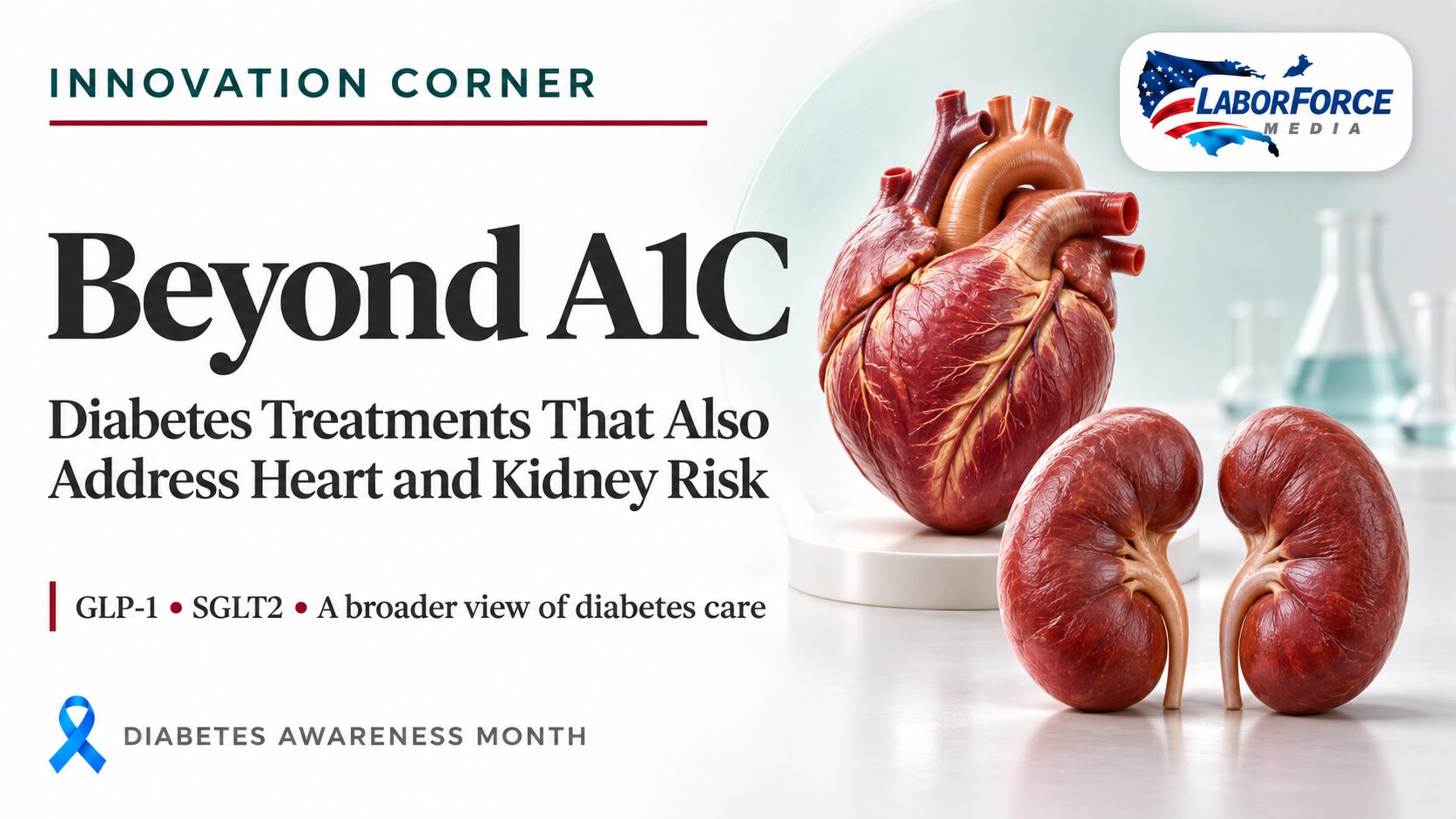
Certain GLP-1 and SGLT2 medicines offer benefits beyond blood sugar control—expanding the conversation about long-term health for working people and their families.
LaborForce Media | Innovation Corner | Diabetes Awareness Month
For years, many diabetes conversations have centered on A1C, a measure of average blood glucose over approximately three months. That number remains important. But it does not tell the whole story.
Heart health, kidney function, blood pressure, and daily quality of life also matter. An encouraging shift in diabetes treatment is bringing these priorities together: certain medicines used for type 2 diabetes can also reduce specific cardiovascular and kidney risks.
For working families, that means a treatment discussion can look beyond the next laboratory result toward protecting health for the years ahead.
Why look beyond blood sugar?
The heart, kidneys, and metabolism are closely connected. Diabetes can damage blood vessels and the kidneys’ filtering system, while kidney disease can increase cardiovascular risk. Addressing these conditions together creates opportunities for earlier, more comprehensive care. NIDDK
The American Diabetes Association’s 2026 guidance recommends medicines with demonstrated cardiovascular or kidney benefits for appropriate people with type 2 diabetes—even when their A1C is already at their individualized goal. Treatment selection depends on the person’s conditions and risk factors. diabetesjournals.org
An A1C at goal does not automatically mean every treatment goal has been addressed.
GLP-1 medicines: benefits beyond glucose control
GLP-1 receptor agonists act on pathways involved in insulin release, digestion, and appetite. Certain medicines in this class have demonstrated cardiovascular benefits in defined patient populations. Their effects and approved uses vary by product. NIDDK
Kidney research has added another important development. The FLOW trial studied 3,533 people with type 2 diabetes and chronic kidney disease. Over a median 3.4 years, injectable semaglutide reduced the relative risk of a combined outcome involving major kidney events or kidney-related or cardiovascular death by 24% compared with placebo.
This was a combined research endpoint—not a 24% reduction in every individual complication. The study was funded by Novo Nordisk. mediacenteratypon.nejmgroup-production.org
In January 2025, the FDA approved an additional indication for Ozempic, injectable semaglutide, to reduce specified kidney and cardiovascular risks in adults with type 2 diabetes and chronic kidney disease. That indication should not be assumed to apply to every GLP-1 product. accessdata.fda.gov
SGLT2 medicines: another route to protection
SGLT2 inhibitors are oral medicines that help the kidneys release glucose and sodium into urine. Certain products can also protect kidney function and reduce heart-failure-related risks in appropriate patients. Some benefits extend to people with qualifying kidney disease or heart failure who do not have diabetes. National Kidney Foundation
The EMPA-KIDNEY trial enrolled 6,609 people with chronic kidney disease, with and without diabetes. Empagliflozin reduced the relative risk of kidney disease progression or cardiovascular death by 28% compared with placebo, over approximately two years. Funding included Boehringer Ingelheim, Eli Lilly, and public research organizations. nejm.org
These studies were not head-to-head comparisons. Their percentages cannot establish which medicine is “better” for an individual.
The right treatment still depends on the person
These medicines offer meaningful possibilities, but they require individualized prescribing.
GLP-1 medicines can cause gastrointestinal symptoms. Some carry important warnings or contraindications; for example, Ozempic is contraindicated for people with a personal or family history of medullary thyroid carcinoma or MEN2. accessdata.fda.gov
SGLT2 inhibitors can increase genital infection risk and contribute to dehydration or low blood pressure. Ketoacidosis is an uncommon but serious risk. Members should obtain specific instructions for illness, fasting, and planned surgery. National Kidney Foundation
For someone working outdoors, driving long routes, or rotating shifts, bathroom access, hydration, meal patterns, and medication tolerance belong in the conversation. These treatments do not replace insulin when it is required.
Questions worth bringing to an appointment
Members can ask:
- What are my heart and kidney risks, beyond my A1C?
- Have I had both a kidney blood test and urine albumin test?
- Could a medicine with proven heart or kidney benefits fit my needs?
- What side effects or workday considerations should we plan for?
- What will coverage, follow-up, and ongoing prescriptions cost?
ADA guidance recommends at least annual assessment using both estimated kidney filtration, or eGFR, and urine albumin-to-creatinine ratio in everyone with type 2 diabetes. doi.org
Make innovation accessible
Union leaders and benefit trustees can help by examining coverage criteria, member costs, authorization support, and continuity of treatment. A prescription offers its greatest practical value when members can obtain it, understand it, and maintain appropriate follow-up.
The opportunity is encouraging: diabetes care increasingly considers how treatment can protect multiple aspects of health while supporting each person’s goals.
Key takeaways
- A1C matters alongside heart and kidney health.
- Certain GLP-1 and SGLT2 medicines offer proven benefits for appropriate patients.
- Evidence, risks, and approved uses differ by product.
- Individualized care and affordable access help turn research into everyday benefit.
References
- American Diabetes Association. Pharmacologic Approaches to Glycemic Treatment: Standards of Care in Diabetes—2026.
Read the guidance - NIDDK. How Obesity and Type 2 Diabetes Affect Heart and Kidney Health.
Read the overview - NIDDK. How To Treat Cardiovascular Disease in People with Diabetes.
Read the clinical discussion - Perkovic V, et al. Effects of Semaglutide on Chronic Kidney Disease in Patients with Type 2 Diabetes. New England Journal of Medicine. 2024;391:109–121.
Read the FLOW trial - The EMPA-KIDNEY Collaborative Group. Empagliflozin in Patients with Chronic Kidney Disease. New England Journal of Medicine. 2023;388:117–127.
Read the EMPA-KIDNEY trial - FDA. Ozempic prescribing information. Includes approved indications, contraindications, and safety information.
View the prescribing information - National Kidney Foundation. SGLT2 Inhibitors.
Read the patient resource - American Diabetes Association. Chronic Kidney Disease and Risk Management: Standards of Care in Diabetes—2026.
Read the guidance
This article is for educational purposes only and does not replace medical advice, diagnosis, or treatment. Talk with your healthcare provider about your individual needs before starting, stopping, or changing any medication or treatment plan.