




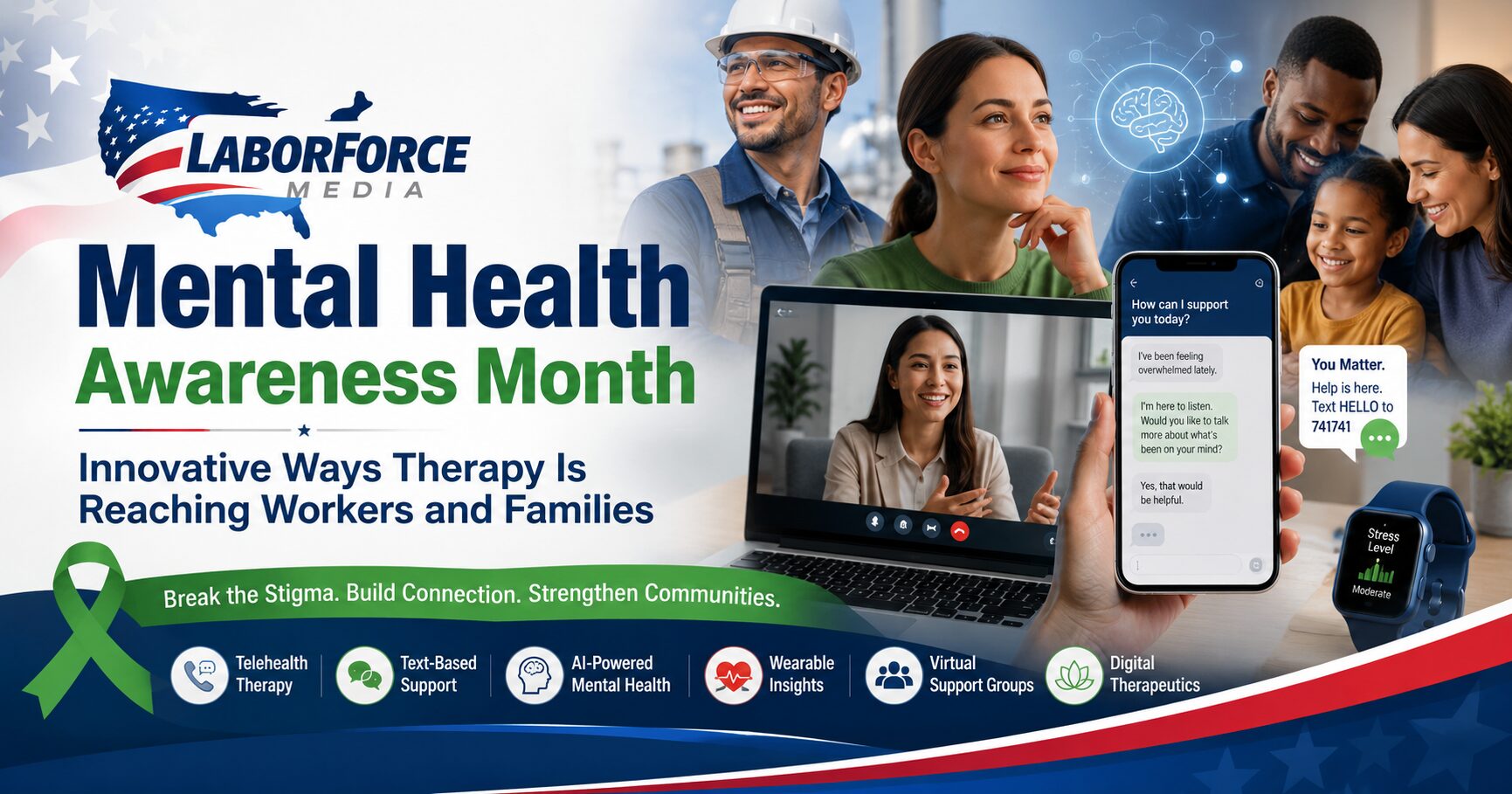
Mental Health Awareness Month is a reminder that support should not be hard to find, hard to schedule, or hard to use. Mental Health Innovation is making it possible to reimagine how we deliver care. For workers, union members, and families balancing long shifts, caregiving, transportation challenges, and demanding schedules, traditional weekly in-office therapy is not always realistic. In fact, Mental Health Innovation continues to shape new forms of accessible care for everyone.
The good news is that mental health care is changing because of continued innovation in mental health solutions and approaches.
Today, therapy and behavioral health support are being delivered in more flexible, accessible, and technology-enabled ways. These innovations do not replace the need for trained professionals, strong benefits, or human connection. But they can help more people get support earlier, more conveniently, and in ways that fit real life. Some of the most impactful advances come directly from Mental Health Innovation in therapy delivery.
Telehealth has become one of the biggest shifts in mental health care. Virtual therapy allows people to meet with licensed therapists by video or phone from home, work, or another private setting. For a single parent, a night-shift worker, a retiree with transportation barriers, or a member living far from a provider, telehealth can remove major obstacles. The American Psychological Association defines telehealth as the use of electronic information and telecommunications technologies to support long-distance clinical care. Clearly, telehealth is an example of mental health innovation improving access to care.
Text-based therapy is another growing option. Platforms such as Talkspace and BetterHelp offer therapy through messaging, live chat, phone, and video options. Talkspace describes its messaging model as asynchronous, meaning a person can send text, voice, or video messages when convenient and receive responses from a licensed therapist based on the care plan. BetterHelp also describes multiple ways to communicate with a therapist, including messages, live chat, phone, and video. Furthermore, thanks to continued innovation in mental health, these platforms are redefining traditional approaches.
For many workers and families, this matters. Not everyone is ready to sit face-to-face and talk. Some people process better in writing. Some need help between sessions. Some can only reach out after the kids are asleep or after a shift ends. Text-based support can lower the barrier to starting. Clearly, these options arise from ongoing Mental Health Innovation in digital support.
Crisis support has also become easier to reach. The 988 Suicide & Crisis Lifeline offers call, text, and chat options for people facing mental health struggles, emotional distress, alcohol or drug use concerns, or crisis situations. For unions, benefit funds, employers, and families, 988 should be treated as essential information: easy to find, frequently shared, and never hidden in fine print. Moreover, the 988 initiative demonstrates how mental health innovation is transforming crisis response.
AI is also entering the mental health space, but it requires caution. AI-powered tools can help with mood tracking, guided exercises, journaling prompts, reminders, screening support, and self-management between appointments. Woebot, for example, describes its mission as making mental health support more accessible through chat-based AI wellness tools. Research reviews have found that AI-driven digital interventions are being explored across screening, treatment support, monitoring, and follow-up. This intersection between technology and mental health reflects ongoing innovation within the space.
But AI should not be treated as a replacement for a licensed therapist, psychiatrist, crisis counselor, or emergency care. The American Psychological Association has warned that generic AI chatbots and wellness apps need safeguards, especially when people use them for serious mental health concerns. The most responsible path is to view AI as a support tool, not the provider. Importantly, the conversation about AI is a key example of Mental Health Innovation and its potential risks and rewards.
Digital therapeutics are another important development. These are software-based interventions designed to deliver evidence-based support. In 2024, Rejoyn became an FDA-authorized prescription smartphone app for major depressive disorder, designed as an add-on treatment under the direction of a healthcare professional. This is an important distinction: regulated prescription digital therapeutics are different from general wellness apps. In addition, many digital therapeutics illustrate how innovation in mental health is driving new treatment options.
Other innovations are also gaining attention. Virtual reality exposure therapy is being studied for conditions such as PTSD, phobias, and anxiety disorders. Reviews suggest VR-based exposure therapy can be a promising tool, especially when guided by trained clinicians. Wearables and remote monitoring may also help identify sleep changes, stress patterns, and behavioral shifts that can support earlier intervention when used appropriately and privately. With these advancements, ongoing mental health innovation is paving the way for future care models.
For union members and families, the message is practical: mental health care is no longer limited to one model. Support may be available by video, phone, text, chat, app-based programs, crisis lines, digital tools, or specialized therapy models. This reflects the expanding range of options brought about by innovation in the mental health sector.
This Mental Health Awareness Month, LaborForce Media encourages every worker and family to review the mental health and behavioral health resources available through their healthcare benefits. Ask what is covered. Ask whether telehealth, text therapy, employee assistance programs, crisis support, family counseling, substance use care, or digital mental health tools are included. These resources may be enhanced by the latest mental health innovation.
Innovation only matters if people can access it. With ongoing innovation in mental health, accessibility keeps improving.
Sources
-American Psychological Association — Telehealth and telepsychology.
-Talkspace — Online text therapy and asynchronous messaging therapy.
-BetterHelp — Therapy by messaging, live chat, phone, and video.
-988 Suicide & Crisis Lifeline — Call, text, and chat crisis support.
-American Psychological Association — AI chatbots and wellness apps advisory.
-Otsuka / Click Therapeutics and FDA-authorized software review — Rejoyn prescription digital therapeutic.
-JMIR / PTSD virtual reality exposure therapy research.
Tags: