




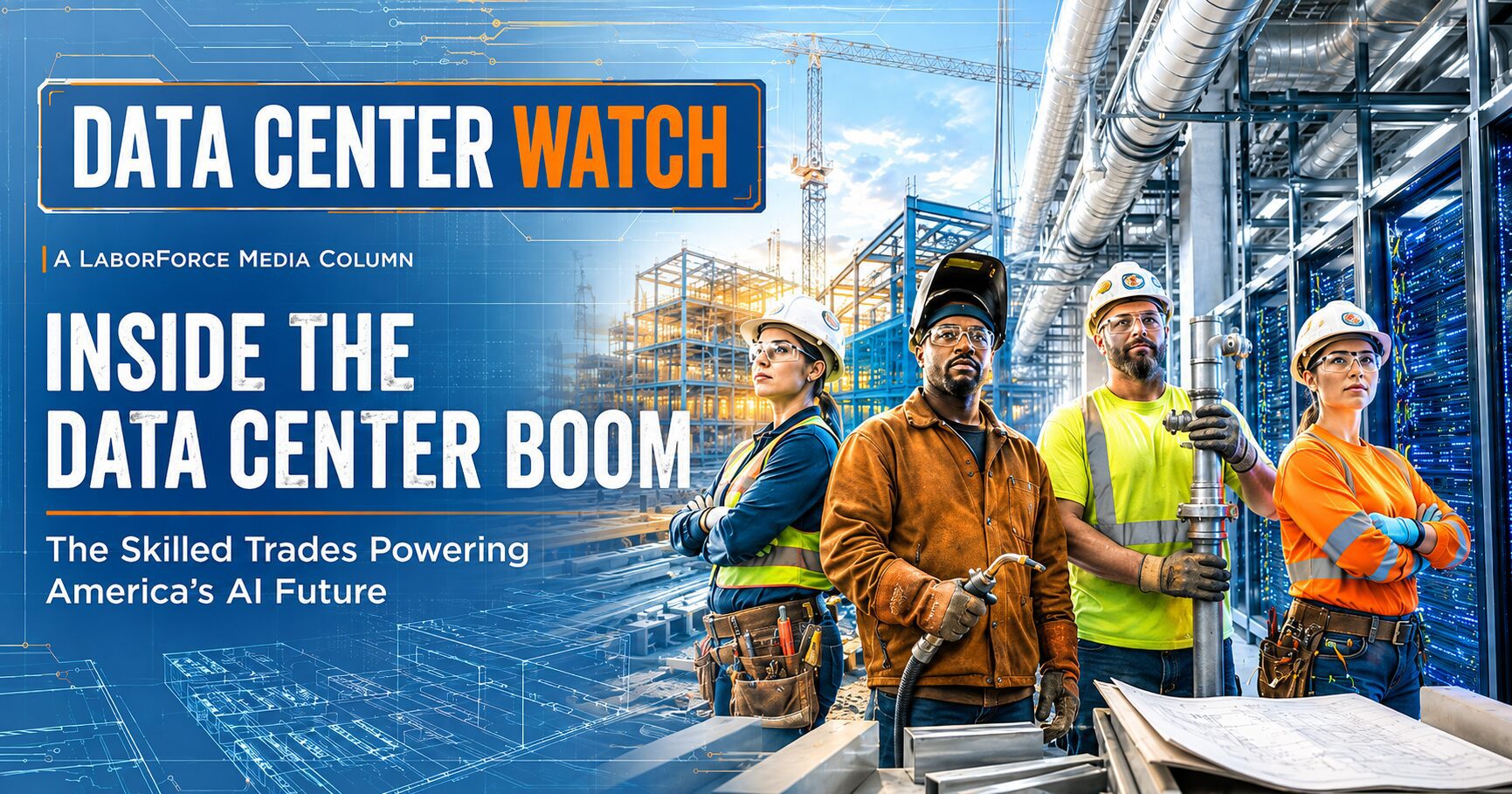
Kerri O’Brien | June 22, 2026This article explores the ongoing Data Center Boom and its impact on industries and communities.
Artificial intelligence may live in the cloud, but the cloud is not weightless.
Behind every AI tool, streaming service, online medical record, financial transaction, video call, and digital workplace is a physical building filled with servers, power systems, cooling equipment, fiber, steel, concrete, backup generators, and security infrastructure. Those buildings are data centers — and they do not build themselves.
They are built by workers.
Electricians. Pipefitters. Plumbers. Ironworkers. Operating engineers. Sheet metal workers. Laborers. Carpenters. Fiber technicians. HVAC technicians. Fire protection workers. Controls specialists. Maintenance teams. The people powering the digital economy are not only software engineers and technology executives. They are also the men and women on job sites, in apprenticeship programs, and in union training centers who turn massive infrastructure plans into operating facilities.
That is why data centers have become one of the most important labor stories in America.
For years, the skilled trades were too often treated as an afterthought in the national conversation about technology. But the AI economy has made one thing impossible to ignore: advanced technology still depends on physical infrastructure. If the country wants more computing power, it needs more power generation, more transmission capacity, more cooling systems, more construction capacity, and more highly trained tradespeople.
The Data Center Coalition describes data centers as “the brains of the internet,” because they process, store, and communicate the data behind the digital services people rely on every day. That simple explanation matters. A data center is not just a building full of computers. It is a mission-critical facility that must run around the clock, remain secure, stay cool, manage enormous electrical loads, and withstand disruptions.
That level of reliability requires skill.
Electricians install and maintain the complex electrical systems that keep facilities operating. Pipefitters, plumbers, and HVAC professionals support cooling systems that prevent servers from overheating. Ironworkers and laborers help build the structure itself. Operating engineers move equipment and manage heavy machinery. Sheet metal workers, fire protection workers, telecom and fiber technicians, and controls specialists all play essential roles in making sure the building functions safely and efficiently.
In other words, data centers are not just technology projects. They are construction, infrastructure, energy, and workforce projects.
North America’s Building Trades Unions has made that point clearly as it engages with major AI infrastructure projects. In announcing a labor agreement connected to the Stargate Michigan data center project, NABTU President Sean McGarvey said the project would be built under a building trades agreement, “guaranteeing the highest standards of safety, training, and craftsmanship.” [1]
That is the labor standard communities should be watching for.
The data center boom will bring opportunity, but not all opportunity is equal. For workers and communities, the important questions are not just whether a project gets built. The real questions are: Who builds it? Are they paid family-supporting wages? Are local apprentices included? Are safety standards clear? Are unions at the table? Are training programs being expanded so young people, veterans, career changers, and underrepresented workers can enter the trades?
These questions matter because the scale of investment is large. According to the Data Center Coalition, a 2026 PwC report found that the U.S. data center industry contributed $926.9 billion to GDP in 2024, supported 5.5 million jobs, and generated $204.4 billion in tax contributions to federal, state, and local governments. [2] The Coalition also notes that each individual data center can take years to construct and may employ hundreds of workers, with more than one thousand professionals on site at peak construction. [3]
That is a major workforce issue.
Technology companies are beginning to recognize it. Microsoft and NABTU recently expanded a partnership to strengthen AI training and career pathways across the skilled trades. The partnership includes no-cost AI literacy courses, industry-recognized credentials, and support for apprenticeship readiness programs. Microsoft President Brad Smith said, “The people building the physical infrastructure of the AI economy…deserve a share in its opportunity.” [4]
That quote captures the heart of the issue.
Data centers should not become another example of wealth being created in communities without workers sharing in the benefits. If these projects are going to reshape local economies, then labor standards, apprenticeship opportunities, safety, and community benefit should be part of the deal from the beginning.
The best version of the data center boom is not just more buildings. It is more skilled careers. More apprenticeships. More union jobs. More local hiring. More training capacity. More young people seeing the trades as a first-choice career.
The skilled trades have always built the backbone of America: bridges, schools, hospitals, power plants, transportation systems, water systems, and homes. Now they are being called on to build the physical backbone of the AI economy.
That creates responsibility for developers, technology companies, policymakers, and labor leaders. It also creates opportunity for workers.
For anyone wondering where the future of work is headed, look past the headlines about algorithms and automation. Look at the construction sites. Look at the apprenticeship classrooms. Look at the electricians pulling wire, the pipefitters building cooling systems, the operating engineers moving equipment, and the union workers raising the infrastructure that the digital economy depends on.
The future may be powered by data.
But it is still built by labor.
LaborForce Takeaway
Before a community approves or celebrates a major data center project, workers and local leaders should ask three questions:
- Will this project use union labor, prevailing wages, or a project labor agreement?
- Will local apprentices and training centers be part of the workforce plan?
- Will the project create long-term economic benefit for workers and the community, not just short-term construction headlines?
Data centers are coming. The question is whether they will be built in a way that respects the workers who make them possible.
Sources:
[1] NABTU announced that the Stargate Michigan project is expected to employ more than 2,500 tradespeople and apprentices, and quoted Sean McGarvey on safety, training, and craftsmanship standards. NORTH AMERICA’S BUILDING TRADES UNIONS ANNOUNCE DATA CENTER AGREEMENT – NABTU
[2] The Data Center Coalition summarizes a May 2026 PwC report finding that the U.S. data center industry contributed $926.9 billion to GDP, supported 5.5 million jobs, and generated $204.4 billion in tax contributions in 2024. Reports & Publications
[3] The Data Center Coalition notes that individual data centers can take multiple years to construct and employ hundreds of workers, sometimes more than 1,000 at peak construction. Reports & Publications
[4] Microsoft and NABTU announced an expanded partnership on April 21, 2026, including AI literacy training and credentials for skilled trades professionals; Brad Smith’s quote is from that announcement. NABTU and Microsoft expand nationwide initiative to strengthen AI training and career pathways across the skilled trades – Source
Tags: