




LaborForce Media| Kerri O’Brien | May 19, 2026
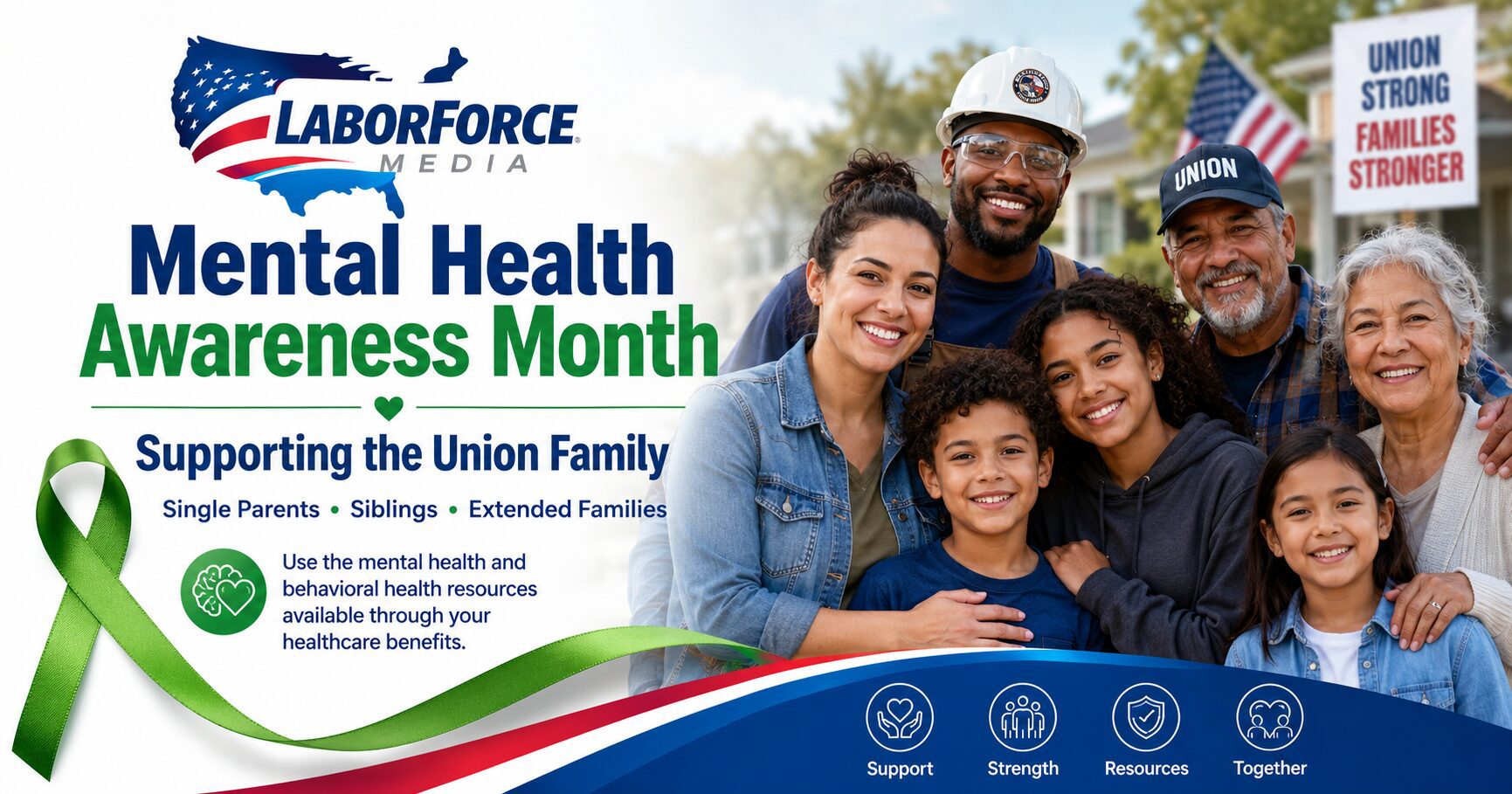
Mental Health Awareness Month is not only about the individual worker. It is also about the family standing behind that worker.
For every union member who shows up on the job, there is often a family carrying the rhythm of that work at home. A spouse managing the household during long shifts. A single parent balancing work, childcare, bills, school schedules, and exhaustion. A grandparent helping raise children. A sibling stepping in during a crisis. A teenager worrying about a parent who seems stressed, distant, or overwhelmed. An extended family trying to stay strong while quietly wondering where to turn for help.
The union family is not one-size-fits-all. It includes single-parent households, blended families, multigenerational homes, retired members, caregivers, siblings, partners, children, and loved ones who support workers through demanding careers. When mental health challenges affect one person, the impact often moves through the entire family.
Stress at work does not always stay at work. Long hours, injury, trauma, financial pressure, job uncertainty, caregiving demands, grief, burnout, and anxiety can show up around the dinner table, in relationships, in parenting, in sleep, and in daily routines. Sometimes families recognize the warning signs before anyone else does.
A loved one may become more withdrawn. A parent may seem short-tempered or exhausted. A child may begin struggling at school. A sibling may stop answering calls. A spouse may carry too much alone. A retired member may feel isolated after leaving the structure and purpose of the job.
These are not signs of failure. They are signs that support may be needed.
For union families, one of the most important steps is knowing what help is already available. Many healthcare benefit plans include mental health and behavioral health services, employee assistance programs, counseling, substance use support, crisis resources, telehealth visits, family therapy, caregiver support, or referral lines. But too often, families do not use these resources because they do not know they exist, do not understand how to access them, or feel unsure about asking for help.
That needs to change.
Mental health support should be treated the same way we treat other forms of healthcare. If a family member had chest pain, a broken bone, or uncontrolled diabetes, we would encourage them to seek care. Anxiety, depression, trauma, grief, burnout, substance use concerns, and emotional distress deserve the same urgency and respect.
This is where union leaders, benefit funds, employers, and families can make a real difference. Benefit information should be easy to find and easy to understand. Mental health resources should be shared more than once a year. They should be included in newsletters, union meetings, family events, onboarding materials, retiree communications, and safety conversations.
Families should also be part of the conversation. A benefit that only reaches the worker may miss the people who are most likely to notice when something is wrong. When spouses, partners, parents, siblings, and caregivers understand the resources available, they can help encourage earlier action.
This month, LaborForce Media encourages every union family to take one practical step: look at your healthcare benefits and identify the mental health or behavioral health resources available to you and your loved ones.
Save the phone number. Visit the website. Ask your benefit fund or union representative where to start. Find out whether telehealth counseling is available. Learn what crisis support exists. Share the information with your family before anyone needs it.
There is strength in preparation. There is strength in asking for help. There is strength in caring enough to check in.
Union families are built on resilience, but resilience should never mean carrying everything alone. It should mean having the tools, support, and community to get through hard moments together.
This Mental Health Awareness Month, let’s expand the definition of worker wellness. Let’s include the single parent, the child, the spouse, the sibling, the caregiver, the retiree, and the extended family.
Because when union families are supported, workers are stronger. Communities are stronger. And the labor movement is stronger.
Call to Action:
Union members and families are encouraged to review the mental health and behavioral health resources available through their healthcare benefits. Contact your union, benefit fund, employer benefits office, or health plan to learn what services are available and how to access support.
Tags: