



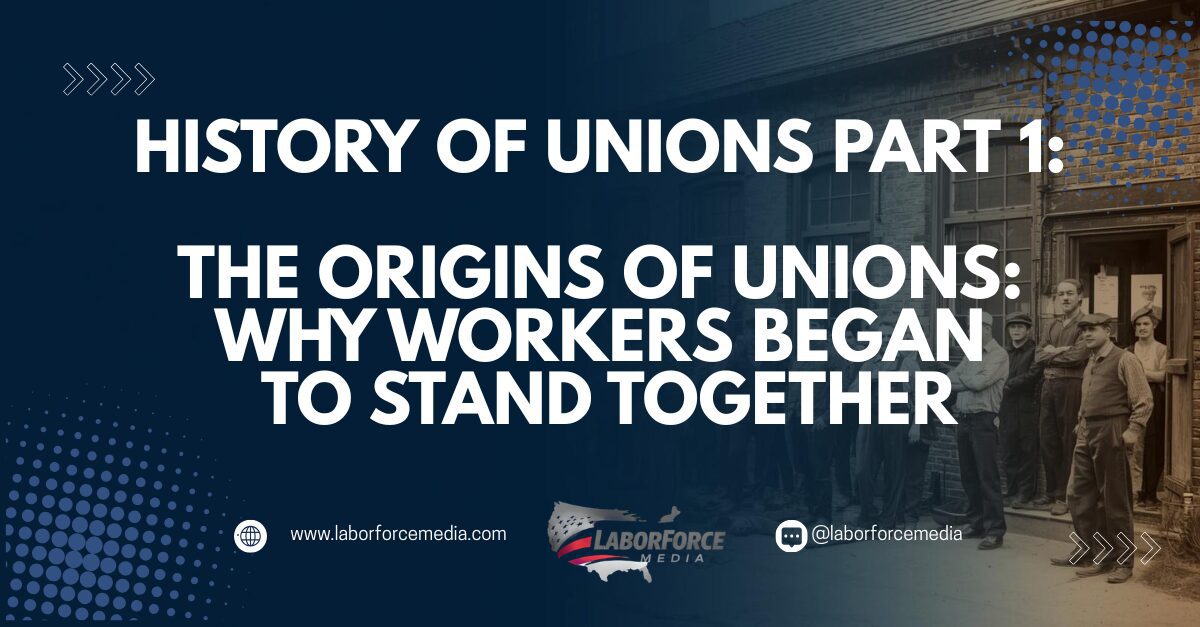
The Origins of Unions: Why Workers Began to Stand Together
Long before unions had formal offices, contracts or national conventions, they began with something simpler and more powerful: workers recognizing that alone they had little leverage, but together they had a voice.
That is the true origin story of unions.
In the early industrial era, work was often dangerous, unpredictable and deeply unequal. Hours were long. Wages were low. Child labor was common. Safety standards were weak or nonexistent. Employers often controlled the terms of work entirely, and workers who objected could be replaced easily. As the U.S. Department of Labor has noted in its history of the American worker, the rise of wage labor brought increasing tension between the people who owned production and the people whose labor made production possible.
Workers did not begin organizing because it was fashionable. They organized because they had to.
At the most basic level, unions were created to answer a hard truth: an individual worker, no matter how skilled or hardworking, usually had far less power than an employer. If one person asked for shorter hours, safer conditions or better pay, that person could be ignored or fired. But if a group of workers made those demands together, management had to listen differently. That is the heart of collective action, and it remains the heart of unionism today. The National Labor Relations Board says the National Labor Relations Act made it clear in 1935 that it is the policy of the United States to encourage collective bargaining and protect workers’ full freedom of association.
The earliest worker organizations were often mutual-aid societies as much as bargaining groups. They helped members during sickness, unemployment or hardship. Over time, many of these associations moved from support alone to action: demanding fairer wages, resisting arbitrary discipline and pushing back against exploitation. According to the U.S. Department of Labor’s account of early American labor history, journeymen’s societies combined mutual aid with direct economic demands, showing that from the beginning, unions were about both solidarity and practical improvement.
That matters because unions did not emerge out of abstract ideology. They emerged out of lived experience.
A worker injured on the job. A family trying to survive on too little pay. Skilled labor being devalued. Exhaustion treated as normal. Children sent into mills and mines instead of classrooms. These were not isolated problems. They were structural problems. And unions were one of the first durable institutions built by workers to confront them.
Over time, organized labor helped drive many of the protections Americans now take for granted. The U.S. Department of Labor notes that the Fair Labor Standards Act of 1938 banned oppressive child labor, established a federal minimum wage and set a maximum workweek for covered industries. Workplace safety regulation also grew from decades of labor struggle and public pressure over dangerous conditions. In its history of the Occupational Safety and Health Act, the Labor Department says the 1970 law established the first nationwide federal program to protect nearly the entire workforce from job-related death, injury and illness.
Unions also helped change the moral vocabulary of work. They made it harder to argue that workers should simply accept whatever conditions the market delivered. They insisted that dignity mattered. Time with family mattered. Safety mattered. Rest mattered. A fair day’s pay for a fair day’s work mattered.
That is one reason union history still feels so relevant.
The union story is not just about strikes and contracts. It is about the larger idea that work should not strip people of health, voice or hope. It is about workers deciding that strength is not only personal grit, but collective courage. And it is about communities learning that when workers rise, the standard for everyone can rise with them.
That is also why LaborForce is motivated to tell this story. Union history is not background material. It is part of the foundation of modern America. Workers acting together helped reshape wages, hours, safety, benefits, bargaining rights and public expectations about fairness on the job. To tell the story of unions is to tell the story of how ordinary people changed history.
And they did change history.
They changed it not because power was handed to them, but because they organized for it. They changed it by turning shared frustration into shared purpose. They changed it by proving that the strength of the collective could move laws, industries and culture.
That is the lesson at the beginning of the union story, and it still holds.
Union Supporter Spotlight
You can still see that spirit in the organizations that stand with labor today. Union One, for example, works exclusively with member-led unions and labor organizations, helping them strengthen operations, direct more resources toward member advancement, and support recruitment, retention and organizing. That kind of work matters because strong unions do not happen by accident. They grow when forward-thinking leaders have the right support behind them and when the mission stays focused on the members themselves.
In that sense, Union One reflects something enduring about the labor movement: unions have always been at their best when they help working people build real stability, trust and lasting loyalty. That is worth celebrating. And it is one more reason LaborForce is proud to keep telling the story of unions, their impact on history, and the collective strength that still powers America forward.
Key Takeaways
- Unions began because individual workers had too little power on their own, according to the National Labor Relations Board and the history of the National Labor Relations Act.
- Early worker organizations combined mutual aid with economic demands, according to the U.S. Department of Labor.
- Organized labor helped drive major gains in wages, hours, child labor protections and workplace safety, according to the U.S. Department of Labor.
- The union story is ultimately about dignity, voice and the power of workers acting together.
Sources
- U.S. Department of Labor, history of the American worker and early labor organizations
- National Labor Relations Board, National Labor Relations Act overview
- U.S. Department of Labor, Fair Labor Standards Act history
- U.S. Department of Labor, history of the Occupational Safety and Health Act
Tags: