



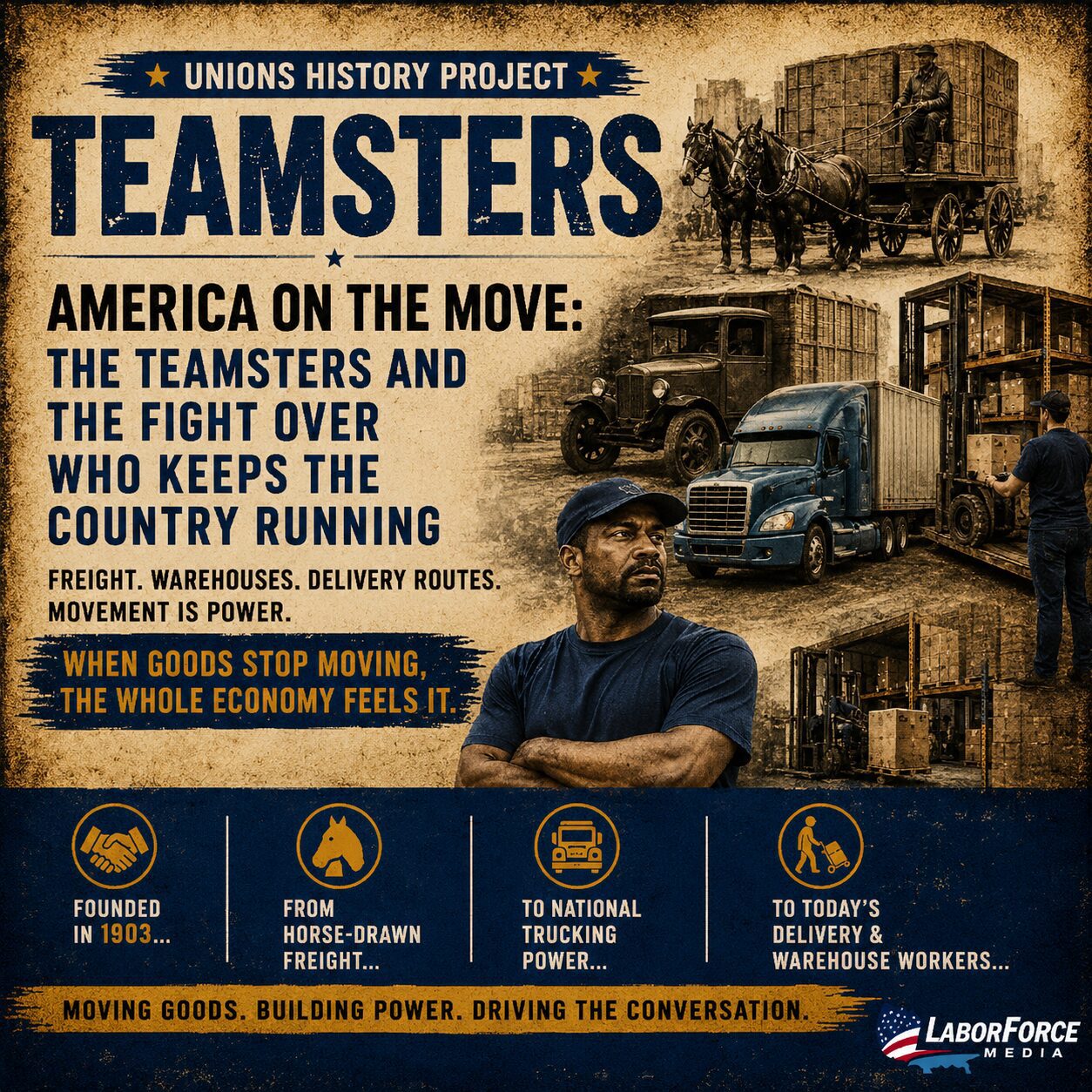
Before the Teamsters became one of the most recognized unions in North America, the history of the Teamsters begins when the country moved by horse, wagon, rail yard, loading dock, and human muscle.
Picture a city street in the early 1900s. Wagons backed up against warehouses. Drivers hauling freight through cold mornings and muddy streets. Packages, coal, food, furniture, and supplies moving from one place to the next because workers made it happen.
Long before the modern delivery truck, the barcode scanner, or the overnight package route, there was already one truth the Teamsters understood better than almost anyone:
When goods stop moving, the whole economy feels it.
That truth became power.
The International Brotherhood of Teamsters was founded in 1903, when two organizations — the Team Drivers’ International Union and the Teamsters National Union — merged to create a stronger national union. Cornelius Shea was elected the first General President. The Teamsters’ own history notes that the early union struggled in a time when labor laws were weak or nonexistent, and companies could use harsh tactics against organizing workers.
The name “Teamsters” came from the workers who drove teams of horses. These workers were not simply moving goods. They were connecting the economy. They carried the materials that made cities function. They delivered what families, businesses, and industries needed to survive.
That gave them a special kind of leverage.
A factory worker could stop a machine. A miner could stop production. But a Teamster could stop movement.
And movement was everything.
The early Teamsters learned quickly that transportation workers had power because they stood at the chokepoints of commerce. Freight had to move. Warehouses had to be loaded. Stores had to be stocked. Coal had to be delivered. Food had to reach markets. Packages had to reach customers.
If the people who moved those goods were underpaid, unsafe, or disrespected, they could organize at the very point where business depended on them most.
That did not mean the road was easy.
The early Teamsters faced brutal opposition. In 1905, the union backed a major strike against Montgomery Ward in Chicago. According to Teamsters history, the strike lasted more than 100 days, cost about $1 million, and took 21 lives. The company ultimately broke the strike, but the lesson remained: transportation labor had enormous power, and employers knew it.
The Teamsters were not just fighting for wages. They were fighting to make a dangerous, unstable line of work into a source of dignity and family security.
Over the decades, the union expanded with the country’s transportation system. As horses gave way to trucks, the Teamsters moved with the technology. Their members became truck drivers, freight workers, warehouse workers, package delivery drivers, mechanics, dockworkers, public-sector workers, and workers across dozens of industries connected by logistics and movement.
The Teamsters’ rise showed something important about modern labor: power does not only come from producing goods. Power also comes from controlling how goods move.
By the middle of the 20th century, the Teamsters had become one of the most influential unions in America. One of the biggest turning points came on January 15, 1964, when the first National Master Freight Agreement was signed in Chicago. The Teamsters describe that agreement as a monumental day in union history. It created standardized protections and benefits for more than 450,000 over-the-road and local cartage drivers across the country.
That agreement mattered because it changed the scale of worker power.
Instead of fighting company by company, local by local, and route by route, the Teamsters helped build national standards across freight. The agreement gave workers more consistent protections and gave the union leverage across an industry that depended on coordination.
That is the Teamsters story in one sentence: control of movement became control of the conversation.
Of course, Teamsters history is also complicated. The union has faced serious controversies, including corruption investigations and high-profile battles over leadership and governance. A real history should not pretend otherwise. But the deeper story is that rank-and-file Teamsters kept showing up, organizing, bargaining, and insisting that the work of moving America deserved respect.
That is why the Teamsters remain so relevant today.
We live in a logistics economy. Packages arrive at doors with a click. Grocery shelves are expected to stay full. Medical supplies must move on time. Construction materials have to reach jobsites. Warehouses run around the clock. Delivery windows are measured in hours.
Behind all of that are workers.
Drivers. Warehouse workers. Sorters. Mechanics. Freight handlers. Dispatchers. Package car drivers. Tractor-trailer drivers. Workers who lift, load, scan, drive, deliver, repair, and keep moving.
The country may talk about supply chains as if they are software systems. But supply chains still depend on people.
That became especially clear in recent years, as e-commerce exploded and delivery work became even more central to daily life. In 2023, Teamsters ratified a five-year national contract with UPS covering more than 340,000 workers. The union said the agreement raised wages for full- and part-time workers, created more full-time jobs, and secured new workplace protections, including air conditioning in new vehicles.
That contract was not just about one company. It was a reminder of the old Teamsters lesson in a new economy: when workers move the goods, workers have leverage.
Today, the International Brotherhood of Teamsters is led by General President Sean M. O’Brien and General Secretary-Treasurer Fred Zuckerman. O’Brien is described by the union as a fourth-generation Teamster who joined Local 25 in Charlestown, Massachusetts, at age 18.
The names and industries have changed since 1903, but the central issue has not.
Who benefits from movement?
The company that owns the route? The corporation that controls the warehouse? The customer who expects the delivery? Or the workers whose bodies, time, skill, and safety make the entire system possible?
The Teamsters have spent more than a century answering that question with organized power.
From horse-drawn wagons to freight highways, from loading docks to package routes, from local strikes to national agreements, the Teamsters’ history is the history of workers who learned that movement is power.
And when the people who move America stand together, they become impossible to ignore.
Key Takeaways
- The International Brotherhood of Teamsters was founded in 1903 through the merger of two early team driver unions.
- The union’s earliest members understood that transportation workers had unique leverage because commerce depends on movement.
- The 1905 Montgomery Ward strike showed both the power of Teamster action and the intense opposition early union members faced.
- The 1964 National Master Freight Agreement helped standardize protections and benefits for more than 450,000 freight workers.
- Today’s logistics economy makes the Teamsters’ history especially relevant because packages, freight, warehouses, and supply chains still depend on workers.
- The Teamsters’ lasting lesson is simple: control of movement can become control of the conversation.
Sources
- International Brotherhood of Teamsters, “Teamster History”
- International Brotherhood of Teamsters, “The Early Years”
- International Brotherhood of Teamsters, “Master Freight Agreement”
- International Brotherhood of Teamsters, “Leadership”
- International Brotherhood of Teamsters, “Teamsters Ratify Historic UPS Contract”
Tags: