



No one knew how to build them. Until now. Union One learned the benefits business in one of the hardest places possible: rail, where an injured worker can be forced to sue their own employer while the paycheck stops for years. That vantage point taught Union One to spot the gaps sitting quietly inside almost every union, including, most likely, yours, and to build the programs that close them.
Ask most benefits companies how they got started, and they’ll tell you what they set out to sell. Union One started with a harder question, because a group of locomotive engineers put it in front of them and there was no easy answer: how does a union railroad worker survive two years with no paycheck while suing their own employer just to keep the lights on?
Before anyone thinks this is only a railroad story, it isn’t. Most injuries and illnesses happen off the job, where workers’ compensation never applies. And a body that simply wears down over time from the work is rarely a comp claim either. The paycheck problem belongs to every member. Rail workers just live the hardest version of it. When a railroader is injured, there’s often no automatic wage replacement. Under the Federal Employers Liability Act, the worker usually has to bring a claim against the railroad and prove the company was at fault. One day you’re an employee. The next, you’re a plaintiff, up against one of the largest corporations in the country with every reason to contest the facts and let the case drag. There’s a word for being run over by something too big to stop: railroaded. The railroads gave America that word. Their own workers have been living it ever since.
And while it drags, the mortgage is still due and the family still needs to eat. The longer it takes, the more pressure the worker feels to settle for less than the claim is worth, not because the case is weak, but because the household can’t wait. That’s not a legal problem. It’s a survival problem.
When that is the first thing you’re ever asked to fix, it changes how you see everything after it. You stop thinking of benefits as products to sell and start seeing them for what they are: the thin line between a family making it and a family going under. And once you’ve identified the worst cases that members deal with, the other gaps facing labor stop being invisible.
“We didn’t learn this in an insurance office. We learned it watching good members go broke because they did not have access to income replacement benefits. After that, you can’t stop seeing where the paycheck disappears.”
-Andrew Haley, President of Union One
That’s the whole point. Union One doesn’t sell products. They build solutions to the everyday money problems working families face away from the jobsite, away from the contract, and in most cases away from the union itself. That is exactly why they can solve problems union leaders can’t. The same kind of gap they learned to spot in rail is sitting quietly inside a lot of unions right now, built into how the systems work, not into anything a union did wrong. A few are worth naming.
Gap one: the health plan fixes the body. It doesn’t replace the paycheck.
You’ve fought hard for good health coverage, and some union health plans are the best in the country. But health insurance treats the injury. It doesn’t cover the weeks of lost income while a member recovers. For a member whose body is their living, that gap decides everything.
Take a journeyman with twenty-six years in the trade. The knee finally goes, not due to an accident or a workers’ comp claim, just decades of kneeling on concrete catching up with them. The health plan covers the replacement in full. What nothing covers is the ten weeks the member can’t work while healing. Ten weeks with no paycheck and a mortgage due is not a choice most members can make. So the member wraps the knee, swallows the pain, and keeps working, until the day the joint gives out for good and a fixable problem becomes the reason they leave the trade five years early. The health plan was excellent, but the member never got to use it to treat the condition that actually ended their career.
No one designed it this way. Health coverage and income replacement benefits are handled by different systems, and most benefit programs never close the gap between them. The fix is voluntary union group income replacement that lets a member actually take the time, get healthy, keep the household stable, and stay in the field longer, paying into the pension through their best earning years.
Gap two: union scholarship programs are built to tell most families “no.”
Unions have funded scholarships for generations, and they do a lot of good, contributing millions of dollars toward union kids’ educations. But look at the structure honestly. Every year, union scholarship programs can reward only a handful of families. They say yes to a few, and no to so many more.
The family that did everything right, showed up, paid dues, raised a good kid, still gets the letter that says not this year. No one built that on purpose. It’s just the nature of a scholarship: a few win, most don’t.
The question worth asking is whether there’s a version where every eligible family can benefit, at no cost to the union and no cost to the member. Union One built the union version of exactly that. Members earn tuition assistance points for the things they’re already doing to build a strong union household: paying their dues, buying or refinancing a home, welcoming a child, enrolling in income protection. Every one of those actions strengthens the household, and every one of them now also builds real dollars for college, up to a full year of tuition at hundreds of participating schools. Keep the scholarships. But in this version, the union is not picking winners and losers. With this version, everyone wins!
Gap three: payroll deduction quietly kills good voluntary benefits.
This one’s the hardest to see, because the idea dies before anyone watches it work. A union wants to offer real voluntary coverage. But most benefit programs require payroll deduction, and plenty of unions can’t run it, won’t manage it, won’t take it on, or would be buried in administration if they tried. So the good idea never launches, and no one ever stops to ask why.
The constraint everyone treats as permanent isn’t, and removing it is bigger than convenience. Union One built their model around direct member payment, so the entire program requires nothing from the employer. No payroll slot. No employer approval. No cooperation, no data handoff, nothing bargained for at the table. That last part is the one most people miss. If another provider walked in with a program like this, the first thing they would need is payroll deduction, and to get it, the union might have to negotiate for it, wait for it, or give something up to land it. That whole obstacle is off the table. The union delivers for its own members without depending on the employer at all: zero employer lift, zero payroll slot, zero employer control. For a union operating in a hostile shop or a hard bargaining cycle, that independence is one of the strongest advantages in the entire portfolio. The Union One promise to leadership is plain: if a program becomes a burden on your union, it’s the wrong program.
Gap four: the biggest bill in a member’s life, and the union has no seat at the table.
Homeownership is the largest financial commitment most members will ever make, and it’s the one moment where the union has traditionally had nothing to offer. Members find their own way to a lender, take whatever rate they’re handed, and navigate the biggest purchase of their lives alone. Then comes the back end nobody plans for: one strike, one layoff, one injury, and the mortgage that was affordable on Friday is a crisis by Monday. It’s the paycheck problem again, aimed at the single largest bill a family carries.
Union One’s homeownership program, HomeAhead, was built to close both ends of that gap. On the front end it helps members understand timing, readiness, and what they can actually afford before they buy, refinance, or tap equity. And once the member is ready, it connects them to preferred lending that has already lowered monthly payments for early participants, in some cases by enough to offset their monthly dues. On the back end it adds a union-backed mortgage relief framework meant to help members hold onto their homes through strikes, lockouts, disability, and the disruptions that come with a working life. It isn’t a lender. It’s the union finally standing next to the member at the kitchen table where the biggest decision of their financial life gets made.
Why you may not have named these yet, and why it isn’t a failing.
None of this comes from union leaders missing something. It comes from where you sit. And most of you came up from the tools. You know what it costs to earn a living with your body, day after day, because you paid that price yourself before you ever held office. Somewhere in your knees, your back, your shoulders, you have known about gap one your whole career. It just never had a name. Your job now is the fight in front of you: bargaining, grievances, organizing, the emergency this week. These gaps don’t surface at the bargaining table. They surface on the worst day of a member’s life, when it is already too late. Union One was handed that vantage point early, in one of the hardest corners of labor there is, and never stopped looking from there.
It matters more now than it used to. After Janus, in a right-to-work environment, members are asking a blunt question: What do I actually get for my dues? “We represent you at the table” is true, and necessary, and no longer a complete answer on its own. What members actually feel happens at the kitchen table: recovering from surgery, sending a kid to school, buying a home, protecting a family. That’s the difference between a member who renews without thinking and one who starts wondering what the dues are for.
So here’s the honest reason to make the call. Not because Union One has products. Plenty of companies have those. Because Union One sees the gaps other benefit providers walk right past, and they know how to turn each one into a real program that lets a union prove its worth to members in terms they can feel.
You already know some of the members these gaps are hurting. The question is no longer whether the gaps exist. They do. The question is whether your union finds them first. Union One was built to help unions find those gaps before their members are forced to live through them.
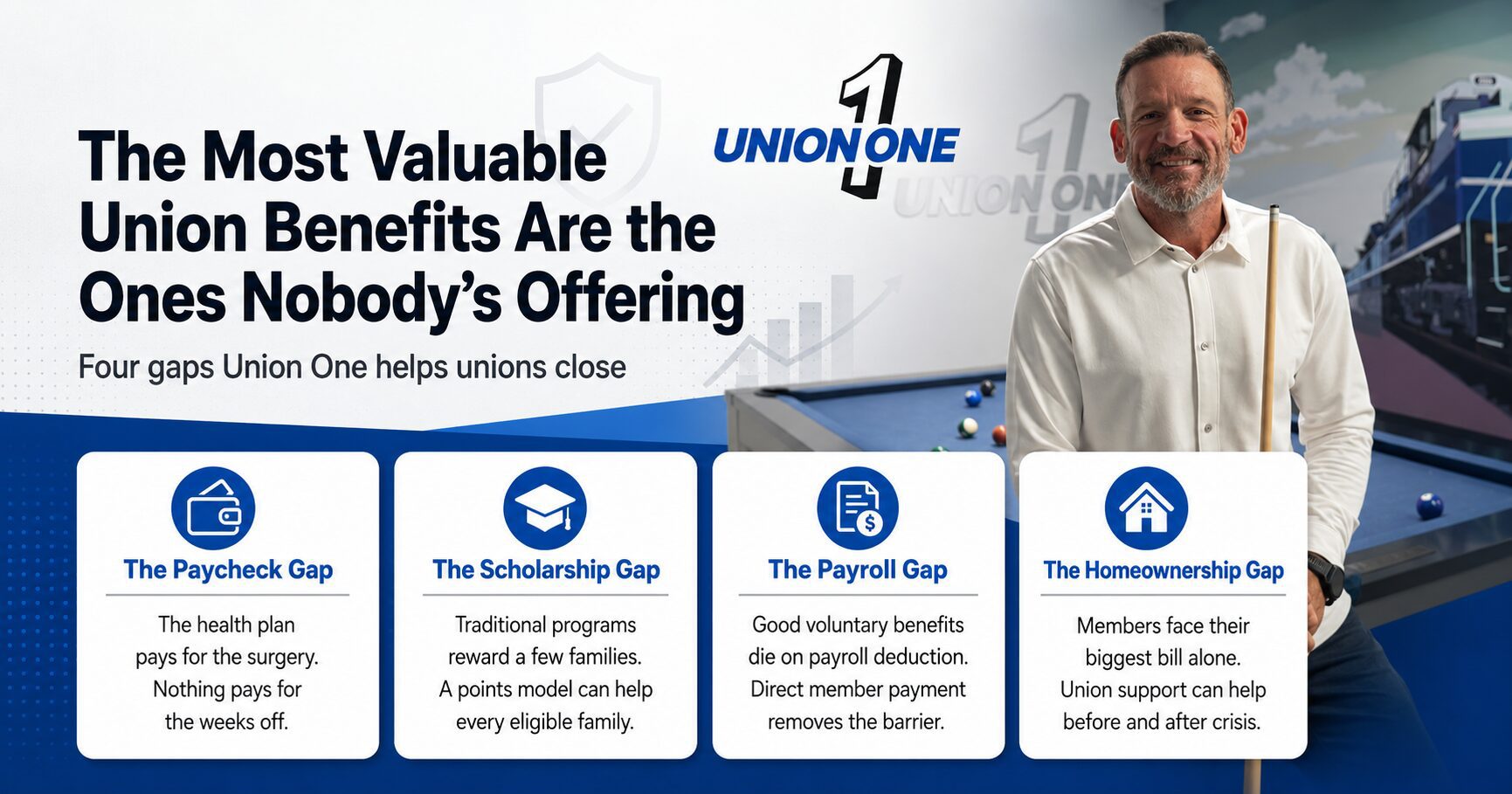
The Four Gaps, In Plain Terms
The paycheck gap. The health plan pays for the surgery. Nothing pays for the weeks off, so members work hurt until a fixable injury ends the career.
The scholarship gap. Traditional programs reward a few families and tell the rest no. A points model lets every eligible family build real college dollars.
The payroll gap. Good voluntary benefits die on payroll deduction. Direct member payment means zero employer lift, zero payroll slot, zero employer control.
The homeownership gap. Members take on the biggest bill of their lives alone, one strike or injury from crisis. Now the union is in their corner on both ends: buying the home right, and keeping it.
Union One builds the programs that close them.
Tags: