




LaborForce Media | Data Center Watch | Kerri O’Brien
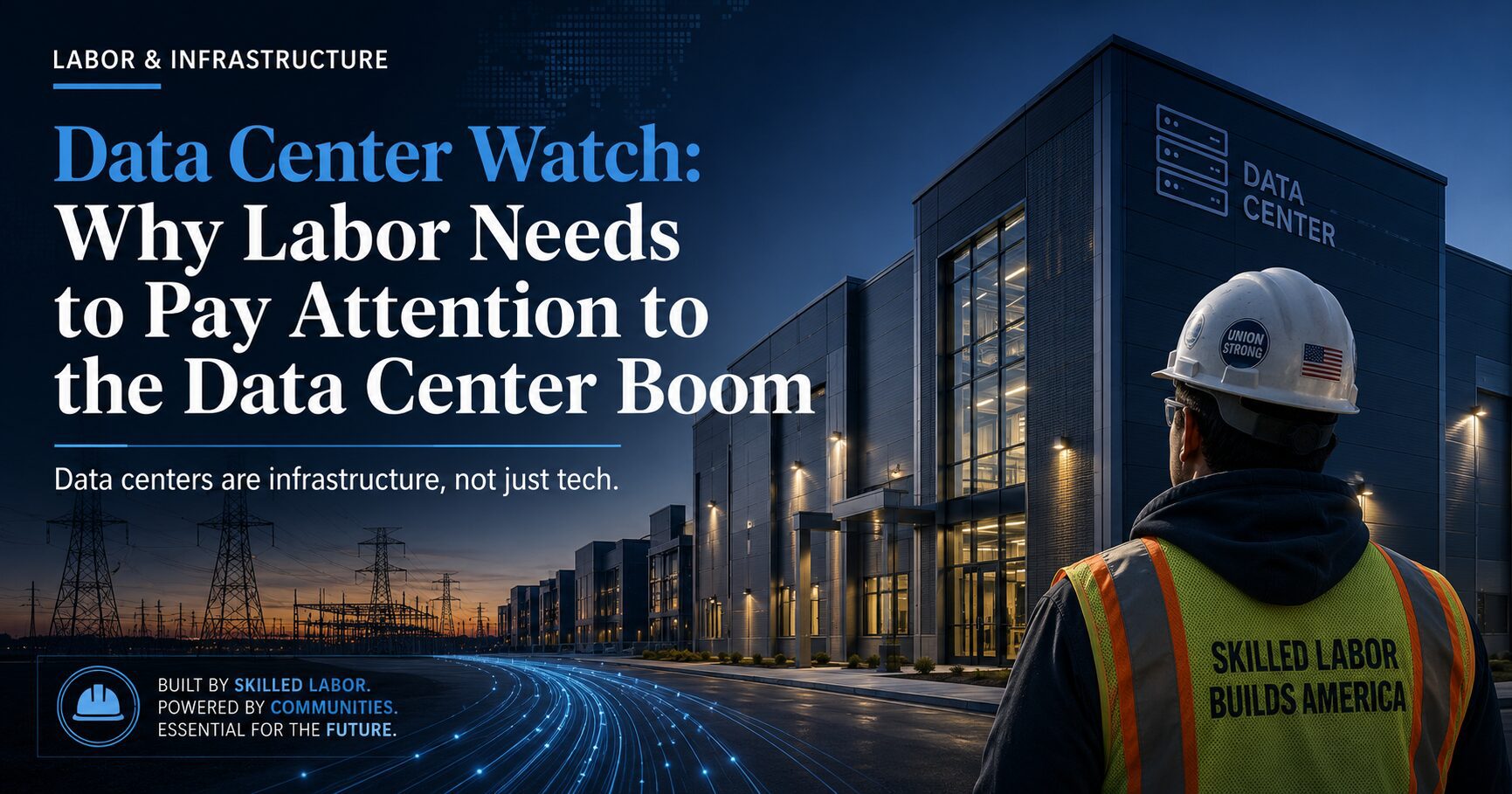
Data centers are infrastructure, not just tech — and the skilled trades will determine how responsibly they are built.
Data centers are often described as technology projects. That framing misses the bigger story.
Before a data center can power artificial intelligence, cloud computing, financial transactions, telehealth, streaming, logistics, public services, or the digital tools people use every day, it has to be built. That means land, power, cooling, concrete, steel, electrical systems, backup generation, mechanical systems, fiber, security, safety protocols, and thousands of hours of skilled labor.
In other words, data centers are not just part of the tech economy. They are part of America’s infrastructure economy.
That is why labor needs to pay attention.
Across the country, data centers are moving from business pages into city halls, county boards, utility commissions, and local community meetings. The debate is no longer limited to investors and technology companies. Communities are asking hard questions about electricity demand, water use, noise, land use, tax incentives, local hiring, transparency, and whether these projects will create real economic benefit.
Those questions are legitimate. If the public conversation is shaped only by developers on one side and opponents on the other, workers can get left out of the story. Labor has a different role to play: demanding that data center development be transparent, accountable, community-aware, and built to the highest safety and quality standards.
That is where union labor matters.
A modern data center is a mission-critical facility. It requires highly trained electricians, operating engineers, laborers, pipefitters, plumbers, HVAC technicians, ironworkers, sheet metal workers, low-voltage technicians, and other skilled trades. These are complex projects where safety, reliability, and workmanship are not optional. When communities ask whether corners will be cut, labor has a clear answer: responsible infrastructure should be built by trained workers under strong labor standards.
This is also a workforce opportunity. Data center construction can support major skilled trades work, apprenticeship pathways, and long-term infrastructure careers. But labor should be honest about the full picture. Data centers may not always create large numbers of permanent operations jobs after construction. That makes it even more important for communities and labor leaders to focus on the quality of construction jobs, the use of local union labor, apprenticeship commitments, workforce development, and community benefit agreements.
The data center boom is also becoming an energy story. New facilities require significant electricity, and in many regions the grid is already under pressure. That does not mean data centers should automatically be rejected. It means utilities, developers, investors, regulators, and communities need to plan responsibly. Power generation, transmission, grid reliability, ratepayer protection, and clean energy investments must be part of the conversation from the beginning.
Water is another issue communities are watching closely. Some data centers use water-intensive cooling systems, while others use air cooling, closed-loop cooling, recycled water, or other approaches that reduce local water impact. The public deserves clear answers about what kind of facility is being proposed, how much water it will use, where that water will come from, and what safeguards will apply during drought or shortage conditions.
This is why Data Center Watch exists.
Each week, LaborForce Media will track the stories shaping the data center buildout: union labor, workforce development, energy demand, water use, community response, policy changes, and major infrastructure investment. Our goal is not to cheerlead every project or oppose every project. Our goal is to help labor leaders, workers, training programs, and community stakeholders understand what is happening and what questions should be asked.
The labor movement should not be on the sidelines of this debate. If data centers are going to power the next era of the American economy, workers should have a voice in how they are built. That means union labor at the table early, apprenticeship programs connected to the opportunity, community standards clearly defined, and public concerns addressed with facts instead of spin.
The issue is not whether data centers are good or bad. The issue is whether they are planned responsibly, built safely, powered intelligently, and held accountable to communities.
Labor has always built America’s critical infrastructure: roads, bridges, tunnels, schools, hospitals, power plants, transit systems, and energy projects. The digital economy is no different. It still depends on physical infrastructure. It still depends on skilled hands. And it still depends on workers who know how to build safely, correctly, and with pride.
The data center boom is here. Labor needs to pay attention because this is not just about servers and software. It is about jobs, training, energy, water, public trust, and who gets to build the infrastructure of the future.
And that future should be built by labor.
Source Links to Follow:
| Source | One-sentence summary |
| BlackRock / GIP / Microsoft / MGX AI Infrastructure Partnership announcement | BlackRock announced a major AI infrastructure partnership focused on new and expanded data centers and related energy infrastructure, with up to $100 billion in total investment potential. (BlackRock) |
| NABTU data center agreement announcement | NABTU announced a historic data center agreement tied to the Stargate Michigan project, positioning union labor as central to major AI/data center construction. (NABTU) |
| NABTU, BlackRock and AIP partnership announcement | NABTU announced a collaboration with BlackRock and the AI Infrastructure Partnership to expand the skilled worker pipeline and strengthen execution for U.S. data center projects. (NABTU) |
| Data Center Coalition FAQ | The Data Center Coalition provides industry-facing answers on jobs, taxes, water, energy, noise, backup generators, and local community impact. (DCC) |
| IEA data center energy analysis | The International Energy Agency reported that data center electricity consumption is projected to roughly double by 2030, with AI-focused power use growing even faster. (IEA) |
| Lawrence Berkeley National Laboratory / DOE data center energy report | Berkeley Lab estimates U.S. data center electricity demand could double or triple by 2028, underscoring why power planning has become central to the debate. (Berkeley Lab News Center) |
| Reuters: Pennsylvania data center rules | Pennsylvania’s governor signed an order adding new environmental, transparency, and local approval rules for AI data centers, showing how states are responding to public concern. (Reuters) |
| Reuters: Texas data center approval pause | Texas ordered a pause on certain new data center approvals pending an audit of energy, water, ownership, incentives, and local impacts. (Reuters) |
| WHYY / Annenberg survey on data center opposition | A University of Pennsylvania survey found public opposition to new data centers rose sharply in 2026, across political lines and levels of AI usage. (WHYY) |
| Laredo Morning Times: resident survey on data center standards | Laredo, Texas is asking residents what standards should apply to data centers, including water, energy, environmental impact, noise, location, and transparency. (LMT Online) |
| ESG Dive: Aligned Data Centers acquisition | BlackRock’s GIP and partners completed a $40 billion acquisition of Aligned Data Centers, showing the scale of capital moving into AI infrastructure. (ESG Dive) |