




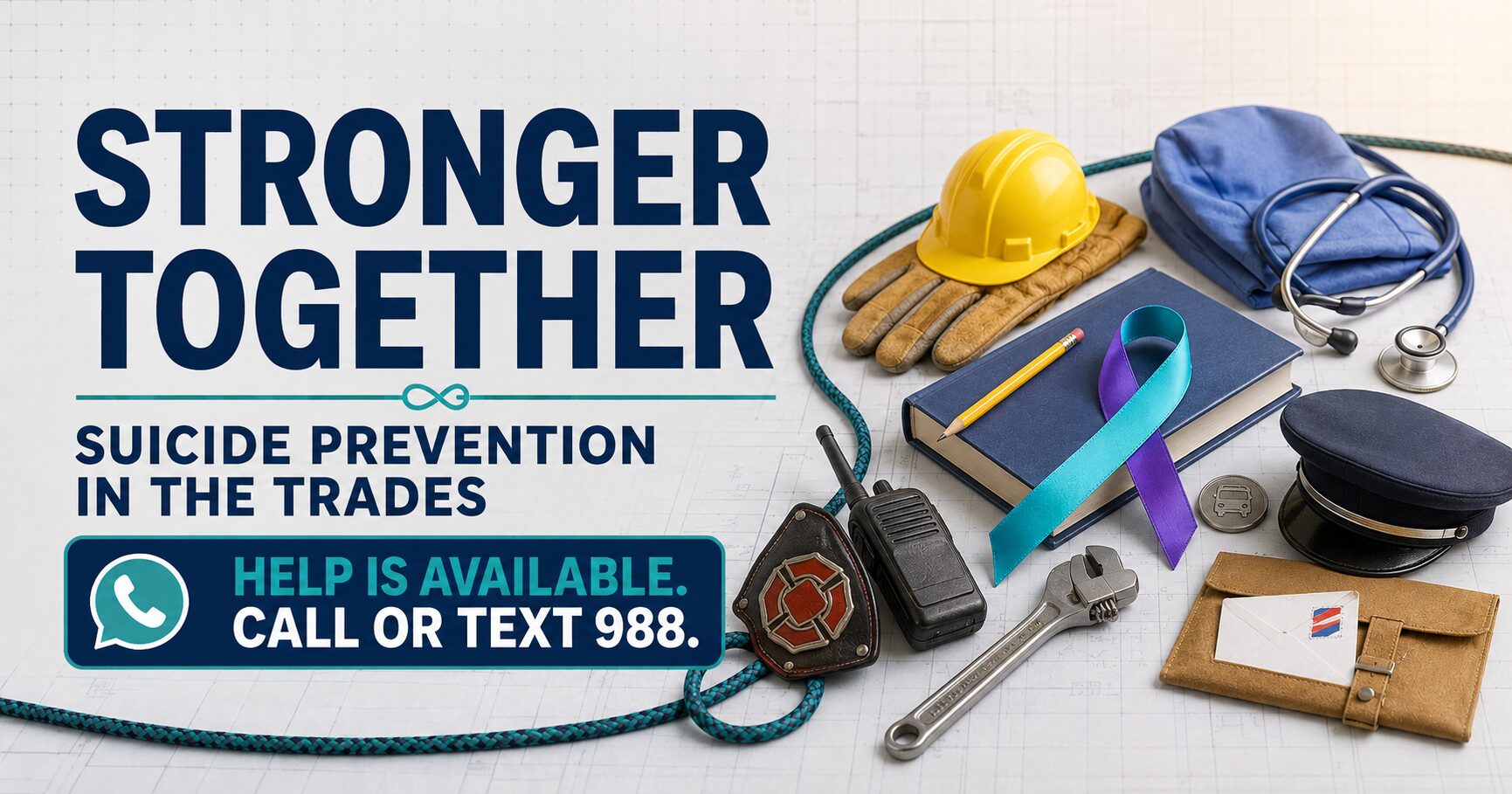
September is National Suicide Prevention Month. For the labor community, it is a time to speak with honesty, listen without judgment, and remind every worker and family that help is available.
It is also a time to remember.
We honor the coworkers, friends, union brothers and sisters, and family members whose lives were lost to suicide. We recognize the grief carried by those left behind—a grief that may include sadness, anger, unanswered questions, or feelings that are difficult to name.
We also stand with those who have experienced suicidal thoughts, survived an attempt, supported someone through a crisis, or traveled a long road toward healing. Your life has value. Your story matters. You are not alone.
Suicide Prevention Is a Labor Issue
The skilled trades are built on strength, reliability, and teamwork. Yet the same culture that teaches workers to push through pain can sometimes make it harder to admit when the weight has become too heavy.
Long hours, job uncertainty, travel away from home, physical pain, workplace injuries, demanding conditions, financial stress, substance use, and time away from family can all affect a worker’s well-being. Suicide is complex, however, and it is never the result of one event or factor.
The numbers show why the labor community must act. According to CPWR—The Center for Construction Research and Training, approximately 5,200 construction workers died by suicide in 2022. That was more than five times the number of construction workers who died from jobsite injuries.
Research from the Centers for Disease Control and Prevention has also identified construction and extraction among the occupational groups with higher suicide rates. Installation, maintenance, repair, transportation, and other labor-intensive fields have faced serious risks as well.
These facts are not a diagnosis of any worker, trade, or industry. They are a call to make emotional well-being part of workplace safety.
Looking Out for One Another
Union workers already understand the principle: no one should face a dangerous job alone. Suicide prevention asks us to bring that same commitment to mental and emotional safety.
A person who is struggling may withdraw from others, speak about feeling hopeless or like a burden, experience major changes in behavior, give away important possessions, use alcohol or drugs more often, or talk about death or suicide. The Substance Abuse and Mental Health Services Administration provides additional information about possible warning signs.
A warning sign does not make us qualified to diagnose someone. It gives us a reason to check in.
Start with a simple, private conversation:
“I’ve noticed you haven’t seemed like yourself. How are you doing?”
Then listen. Do not rush to solve the problem, compare experiences, or tell the person to “toughen up.” Let them know they matter. Encourage them to connect with trained support, and stay with them while they make that connection when possible.
Taking someone seriously is not an overreaction. It is an act of care.
Building a Stronger Culture in the Trades
Union leaders, employers, apprenticeship programs, benefit funds, and contractors can help create workplaces where seeking help is treated as a strength.
That can include placing crisis information on jobsites, discussing mental health during safety meetings, training supervisors and stewards to recognize concerning changes, promoting employee assistance programs, and making behavioral health benefits easier to understand and use.
It also means changing everyday language. Jokes that shame people for struggling can keep a worker silent. Respectful conversations can open a door.
The goal is not to turn coworkers into counselors. It is to build a culture in which workers notice, ask, listen, and connect one another with qualified help.
Help Is Available Now
If you or someone you know is experiencing emotional distress or thoughts of suicide, call or text 988 or use the online chat at the 988 Suicide & Crisis Lifeline. The service is available 24 hours a day, seven days a week across the United States and its territories. Support is free and confidential.
You do not need to wait until the situation feels unbearable to contact 988. Workers and family members can also reach out when they are worried about someone else.
If there is an immediate danger or medical emergency, call 911 or go to the nearest emergency department.
Additional support may be available through a union benefit fund, employee assistance program, health plan, primary care provider, behavioral health professional, faith community, or trusted local organization.
Together, We Can Carry the Load
The labor movement was built on a powerful promise: together, we can face what no worker should have to face alone.
We can remember those we have lost with compassion. We can stand beside families carrying grief. We can honor people with lived experience. We can make room for honest conversations on jobsites, in union halls, and around kitchen tables.
Most importantly, we can remind one another that asking for help is an act of courage—and that hope can begin with one conversation.
In the trades, we watch each other’s backs. That commitment can save a life.