




LaborForce Media | Union History Series | September 2, 2026
There was a time when connecting one person to another could require an operator sitting in front of a switchboard, physically moving cords from one jack to another.
A telephone call was not something that simply happened.
Someone helped make the connection.
Then came dial phones. Long-distance networks. Fiber optics. Cellular service. The internet. Cable television. Smartphones. Digital journalism. Remote work. Streaming. Video games. Artificial intelligence.
Each new technology changed the way Americans communicated.
And every change raised another question:
What happens to the workers when an entire industry reinvents itself?
For the Communications Workers of America, or CWA, that question has defined nearly a century of union history.
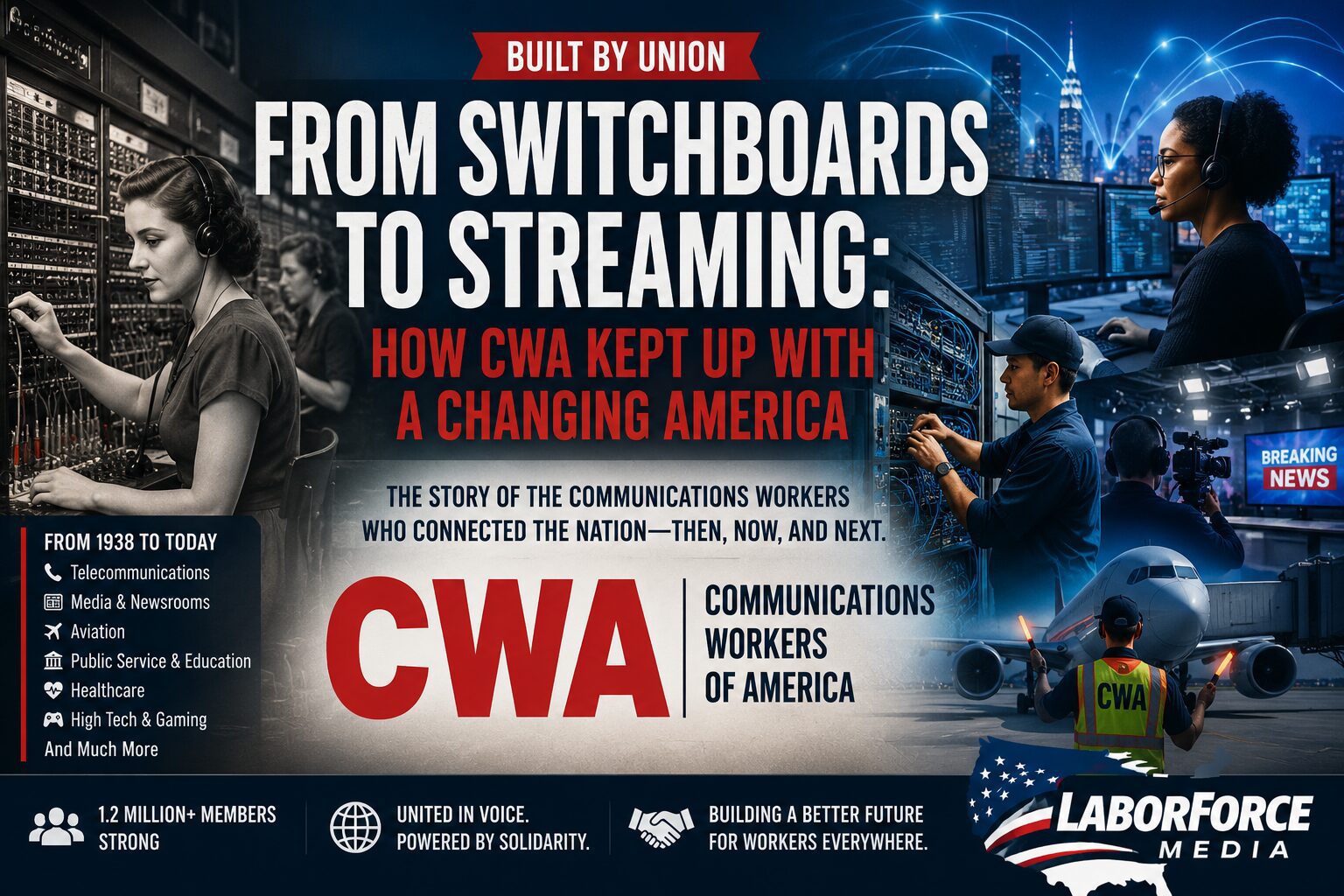
CWA began with telephone workers. Today, its members work across telecommunications, media, airlines, public service, higher education, healthcare, manufacturing, high tech, video games, and other industries. The union says it represents workers through roughly 1,200 chartered local unions across the United States, Puerto Rico, and Canada.
That transformation makes CWA one of the clearest examples of an important lesson in labor history:
If work changes, unions have to change with it.
Before Everyone Carried a Phone
To understand CWA, picture America in the first half of the 20th century.
Telephones were rapidly becoming essential to business and everyday life, but the national communications network depended on an enormous workforce.
Operators connected calls.
Installers ran lines.
Repair workers climbed poles and maintained equipment.
Technicians kept switching systems operating.
Clerical and customer-service employees kept the system functioning behind the scenes.
Telephone work was becoming part of the infrastructure of modern America.
But the workers inside that system were fragmented.
CWA traces its origins to 1938, when telephone-worker organizations came together to form the National Federation of Telephone Workers, or NFTW. Less than a decade later, in 1947, the organization adopted the name Communications Workers of America.
The new name turned out to be remarkably forward-looking.
The union was no longer defining itself around a single device.
It was defining itself around communication.
That distinction would become increasingly important.
A Nationwide Strike Changes the Union
One of the defining moments in CWA’s early history came in 1947.
Telephone workers were facing an industry dominated by the Bell System, an enormous network of telephone companies linked to AT&T.
Workers across the country launched a nationwide telephone strike.
The strike lasted several weeks and became an important test of whether geographically scattered telephone workers could act together as a national force. CWA’s own history places the 1947 strike at the center of the transition from the National Federation of Telephone Workers into a stronger national organization.
Think about the challenge.
These were workers spread across cities, states, telephone companies, and different jobs.
But the network itself connected the country.
Workers began building a union that could do the same.
The communications infrastructure might have been technological.
The union infrastructure was human.
Then Technology Started Moving Faster
For many unions, one of the hardest challenges is not simply winning a contract.
It is surviving a changing industry.
CWA has faced that challenge repeatedly.
Mechanical switching replaced some manual telephone work.
Electronic systems replaced mechanical ones.
Digital communications replaced analog technology.
Fiber optics changed networks.
Wireless phones changed consumer behavior.
The internet blurred the distinction between telecommunications, media, and computing.
And eventually, the device that once sat on a table in your house became a small computer carried in your pocket.
Every technological leap created new jobs.
It also threatened old ones.
That created a complicated role for the union.
CWA could not simply fight to preserve every job exactly as it had existed decades earlier.
It had to fight for workers to have a place in whatever came next.
That is a very different idea.
The People Behind the Network
Today, most of us think of communications technology as nearly invisible.
Tap a screen.
Send a message.
Stream a movie.
Upload a file.
Join a video call.
The connection appears almost instantly.
But digital life still depends on people.
Someone installs and repairs fiber.
Someone maintains networks.
Someone staffs customer-service operations.
Someone produces broadcasts.
Someone reports and edits the news.
Someone maintains software and technical systems.
Someone keeps airports and airlines functioning.
Someone works inside the universities, healthcare systems, and public agencies that depend on communications technology every day.
CWA’s membership reflects just how broad that workforce has become. Among the union’s major sectors are telecommunications, broadcast and cable television, news media, airlines, public service, higher education, healthcare, manufacturing, and high technology.
That is a long way from the telephone switchboard.
But the central labor question is familiar:
When technology changes the workplace, who gets a voice in deciding what happens to the people working there?
From Telephone Workers to Newsroom Workers
One of the most interesting chapters in CWA’s evolution came through journalism.
The organization now known as The NewsGuild-CWA actually began separately.
The American Newspaper Guild formed in 1933, during the Great Depression, after columnist Heywood Broun helped rally newspaper workers around the idea that journalists and other newsroom employees were workers too.
For much of the 20th century, the Guild represented employees at newspapers and news organizations.
Then journalism itself began changing.
Computers entered newsrooms.
Print publications faced digital competition.
Entirely digital news organizations appeared.
The definition of a “newsroom” expanded.
In 1995, Newspaper Guild members approved a merger with CWA, becoming a sector of the larger communications union. The organization later changed its name to The NewsGuild in 2015, reflecting a media world no longer centered solely on printed newspapers.
Today, NewsGuild members include journalists as well as workers at digital publications, publishing houses, nonprofits, and other media organizations.
The evolution is almost a perfect snapshot of the broader CWA story.
A union that once organized telephone workers became home to workers producing journalism delivered over the same digital networks telecommunications workers helped build.
When “Communications” Became Almost Everything
The word communications meant something fairly specific in 1947.
Today, it touches almost every industry.
That has allowed CWA to expand in unexpected directions.
The union includes the Association of Flight Attendants-CWA, representing flight attendants at more than 20 airlines.
It includes IUE-CWA, whose members work in manufacturing sectors including aerospace, automotive, furniture, and appliances.
Its public, healthcare, and education sector includes employees ranging from educators and healthcare providers to programmers, equipment operators, and public-safety workers.
And CWA now explicitly identifies high tech and video games among the fields where its members work.
For a student considering a career in technology, journalism, media, aviation, public service, or communications, that may be surprising.
Union jobs do not exist only in factories and construction sites.
They exist in the digital economy too.
Organizing the People Who Build the Digital World
That may become one of the most important chapters in CWA’s future.
Technology companies have transformed daily life, but many technology workers are now asking questions workers in older industries asked generations ago:
Who determines working conditions?
What happens during layoffs?
How transparent are promotion and compensation decisions?
What protections exist when technology changes a job?
Who owns the consequences when automation eliminates work?
And what voice should employees have in the development of the technologies they are being asked to build?
These questions feel modern.
The underlying issue is not.
It is still about power inside the workplace.
CWA’s expansion into high-tech and digital work shows how organized labor is trying to follow workers into industries that barely existed when many traditional unions were created. Its current membership spans high tech and video games along with its longer-standing telecommunications and media sectors.
That may be the clearest reason CWA belongs in a series about the future as much as the past.
The Pandemic Put Communications Work at the Center of Life
Then came 2020.
Millions of people suddenly depended on communications networks in ways they never had before.
Schools moved online.
Office workers went home.
Families used video calls to stay connected.
Doctors delivered appointments through telehealth.
Newsrooms operated remotely.
Businesses depended on broadband simply to function.
At the same time, many workers still had jobs that could not be performed from a dining-room table.
CWA says it negotiated significant work-from-home accommodations during the COVID-19 pandemic as well as pandemic-related agreements covering workers in telecommunications, broadcasting, media, public service, airlines, healthcare, and other sectors.
COVID made something visible that technology often hides:
The digital economy still depends on human beings.
There is no cloud without infrastructure.
There is no reliable broadband without people maintaining networks.
There is no news without journalists and production workers.
There is no customer service without workers responding to customers.
And there is no technological transformation without people experiencing its consequences.
Leadership From the Communications Industry Itself
CWA’s current president, Claude Cummings Jr., has lived through much of this technological transition personally.
Cummings began working for Southwestern Bell Telephone Company, now part of AT&T, in 1973. He worked as a frame attendant and communications technician and maintained communications systems for customers that included NASA.
He later became president of CWA Local 6222, representing more than 8,000 members, before serving in other national leadership roles.
In July 2023, Cummings was elected president of CWA, becoming the first Black man to lead the union.
CWA members also elected Ameenah Salaam secretary-treasurer in 2023, making her the first Black woman to hold that position.
Her path also began inside the industry. Salaam started working for Diamond State Telephone in 1991 as a customer-service representative and became a union steward before moving through CWA leadership.
Both stories reinforce something we have already seen across the Built by Union series:
National union leaders often begin as workers doing the jobs their unions represent.
A Union Still Changing in 2026
CWA’s evolution is not just historical.
It is happening now.
As of August 2026, the union continues organizing across newer and traditional occupations. Recent CWA activity includes organizing among ATM technicians and organizing and bargaining activity involving broadcast and other communications workers.
Meanwhile, the technological questions facing those workers are getting bigger.
Artificial intelligence is changing customer service.
Automation is changing technical jobs.
Media companies are experimenting with AI-generated content.
Telecommunications companies continue modernizing networks.
Employers increasingly collect and analyze worker data.
And algorithms can influence everything from scheduling to productivity measurement.
The tools have changed dramatically since 1938.
The fundamental question has not:
How much influence should workers have over the future of their own work?
From the Switchboard to Whatever Comes Next
Imagine showing a smartphone to one of the telephone operators who helped build the National Federation of Telephone Workers in 1938.
She might not recognize the device.
But she would probably recognize the workplace questions surrounding it.
Will technology eliminate jobs?
Will new jobs pay well?
Will workers receive training?
Will productivity gains benefit employees as well as companies?
Will technological change make work safer and better—or simply faster and more demanding?
And will workers get any say?
Those questions connect the telephone workers of the 1930s to today’s journalists, broadband technicians, customer-service representatives, flight attendants, healthcare workers, software employees, and video-game workers.
The technology changed.
The need for worker voice did not.
Built by Union
The Communications Workers of America offers an important lesson about organized labor.
A union does not survive for generations by pretending the workplace never changes.
It survives by understanding what should change and what should not.
The equipment can change.
Industries can change.
Job titles can change.
The way people communicate can change completely.
But workers still want fairness.
They still want safety.
They still want economic security.
They still want respect.
And they still want some influence over decisions that can transform their careers and their lives.
CWA began in a world of telephone lines and switchboards.
Today its members work across broadband networks, newsrooms, airlines, universities, healthcare systems, manufacturing plants, digital media, high tech, and video games.
What comes next may look nothing like the communications industry of today.
History suggests CWA will try to follow workers there too.
Why LaborForce Media Is Telling These Stories
Built by Union is LaborForce Media’s ongoing effort to document the workers, organizations, struggles, innovations, and turning points that shaped America’s labor movement—and continue shaping the future of work.
For younger workers especially, the CWA story matters because it challenges an outdated idea that unions belong only to old industries.
Sometimes the opposite is true.
The more quickly an industry changes, the more important the question of worker voice may become.
Subscribe to Built by Union and share this story with a student considering a career in technology, media, journalism, communications, aviation, or another field being transformed by technology.
Sources
Communications Workers of America, CWA History
Communications Workers of America, CWA Overview
Communications Workers of America, About CWA
Communications Workers of America, Leadership
The NewsGuild-CWA, History and About